
Quick Answer
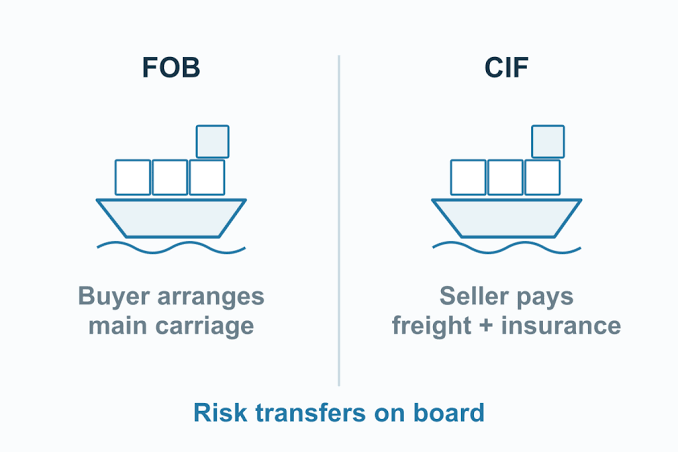
CIF and FOB are Incoterms that decide where a seller's responsibility ends. Under FOB, the seller clears the goods for export and delivers them on board the vessel, and the buyer pays freight and insurance from that point. Under CIF, the seller also pays freight and minimum insurance to the destination port, but risk still passes to the buyer once the goods are loaded. In short, FOB gives the buyer control of shipping costs, while CIF gives the seller control and bundles those costs into the invoice.
---
What CIF and FOB Actually Mean
Every import negotiation eventually reaches the same question. Who books the ship, who pays the freight, who buys the insurance, and at what moment do the goods become the buyer's problem?
CIF and FOB are two of the eleven Incoterms rules published by the International Chamber of Commerce. They are three letter trade terms that allocate cost, risk and paperwork between a buyer and a seller. They do not replace the sales contract, and they do not decide payment timing, but they do decide who spends money on transport and insurance.
The full rules are published by the International Chamber of Commerce, which updates them periodically. The current set is Incoterms 2020. Both CIF and FOB belong to the group of rules that apply only to sea and inland waterway transport, which is why they appear so often in container, bulk and project cargo deals.
FOB stands for Free On Board. CIF stands for Cost, Insurance and Freight. The naming already hints at the difference. One stops at the ship's rail. The other keeps spending until the cargo reaches the destination port.
The Three Things Every Incoterm Decides
Importers often treat trade terms as a formality and then discover the cost later. A better habit is to read every term against three questions.
Cost. Who pays for export clearance, loading, main carriage, insurance, destination charges and import duty? Incoterms allocate these items precisely, and a term that looks cheap at the quotation stage can be expensive once the missing items are added.
Risk. At what physical point does loss or damage become the buyer's problem? This matters more than cost. A seller can pay freight to the destination port and still hand over risk at the origin port.
Paperwork. Who arranges the transport document, the insurance certificate and the export declaration? Missing documents are the most common reason cargo sits at a port while storage charges climb.
Once these three questions are clear, CIF and FOB stop being jargon and become pricing decisions.
CIF in Practice: What the Seller Covers
Under CIF, the seller handles export clearance, pays for loading, books and pays the main carriage to the named destination port, and buys insurance that covers the buyer's risk during transit. The insurance cover required by the rule is minimum cover, usually Institute Cargo Clauses C, which is narrower than most importers assume.
The critical detail is the risk transfer point. Under CIF, risk passes to the buyer when the goods are loaded on board at the port of shipment, even though the seller has paid freight all the way to destination. If the vessel is damaged in a storm halfway across the ocean, the buyer owns that loss and must claim on the insurance policy the seller arranged.
That split between cost and risk confuses first time importers. It is also why the insurance document matters so much. The buyer needs the certificate, endorsed correctly, in order to claim.
CIF suits buyers who want one landed price from the supplier, who lack a freight forwarder relationship, or who are buying small volumes where negotiating ocean freight separately is not worth the effort. It also suits buyers who would rather not manage a shipping line directly.
The trade-off is visibility. The seller chooses the carrier, the routing and the insurance cover. The buyer sees an all in number and cannot easily tell whether the freight component is fair.
FOB in Practice: Where the Buyer Takes Over
Under FOB, the seller clears the goods for export and delivers them on board the vessel nominated by the buyer. From that moment, the buyer pays freight, insurance, destination charges and import clearance.
FOB gives the buyer control. You choose the forwarder, you see the ocean freight rate, you decide the insurance cover, and you know what each leg costs. For regular importers moving consistent volumes, that control usually produces a lower total cost, because freight is negotiated directly rather than marked up inside a supplier's quotation.
The trade-off is work. The buyer must nominate a vessel, coordinate with the forwarder, arrange insurance, and manage documents. A buyer who is not ready for that will find FOB slower than CIF in practice, even though the rate looks better on paper.
FOB also creates a timing risk that catches new buyers. The seller delivers to the port, but the buyer's vessel must be there. If the vessel is late, storage and demurrage charges can start accruing before the cargo is even loaded. That is a buyer cost under FOB.
CIF vs FOB Side by Side
| Decision | CIF | FOB |
|---|---|---|
| Export clearance | Seller | Seller |
| Loading on board | Seller | Seller |
| Main ocean freight | Seller | Buyer |
| Transit insurance | Seller, minimum cover | Buyer |
| Risk passes | On loading at origin | On loading at origin |
| Destination charges | Buyer | Buyer |
| Import duty and clearance | Buyer | Buyer |
| Control of carrier and route | Seller | Buyer |
| Best fit | Occasional or small volume buyers | Regular importers with forwarder relationships |
The table shows why CIF and FOB are often described as mirror images. The real difference is who pays the middle of the journey, not who carries the risk.
Which Term Fits Your Import
There is no universally better term. The right choice depends on volume, experience and cash flow.
Choose CIF when you are testing a new supplier, when the order is small enough that a separate freight negotiation would cost more in time than it saves, or when you have no forwarder relationship and want a single invoice that covers delivery to port.
Choose FOB when you import regularly, when you already have a forwarder with better rates, when you want full insurance cover rather than the minimum, or when you need to control routing because of transit time or port congestion.
A practical middle path for growing importers is to request both quotations. Ask the supplier for a CIF price and an FOB price for the same goods, then ask your forwarder what the freight and insurance would cost under FOB. The gap between the two answers is the supplier's freight margin, and it is often larger than expected.
The Cost Trap: Freight, Insurance and Landed Cost
Landed cost is the only number that matters. It includes the goods, freight, insurance, port charges, clearing, duty, levies and the cost of moving cargo from the port to your warehouse.
Under CIF, the invoice hides part of that stack. The buyer sees a single figure and may not realise that destination charges, which can be substantial, are still on their account. Under FOB, each line is visible, which makes budgeting easier but requires more work upfront.
Insurance deserves separate attention. Minimum cover under CIF is not the same as full cover. If your cargo is high value, perishable, or vulnerable to water damage, you may need Institute Cargo Clauses A, which is wider cover. Buyers who assume the seller's policy protects them fully are the ones who discover the gap during a claim.
Duty is calculated on customs value, and the transport and insurance components can affect that valuation depending on the destination country's rules. The UK government import guidance sets out how value is assessed for imports into the UK, and most customs authorities follow a similar logic. Getting the valuation right at declaration stage prevents later adjustments and penalties.
Documents That Must Match the Term
Trade documents are checked against each other. A mismatch between the invoice, the bill of lading and the insurance certificate is a common cause of delay.
Under CIF, the seller must provide a transport document covering carriage to the named destination port and an insurance document. The invoice should state the term, the named port and the Incoterms version, for example CIF Lagos Incoterms 2020. Under FOB, the bill of lading should show the named port of shipment and the buyer's nominated vessel.
Three habits prevent most document problems. State the Incoterm and the named place on every invoice. Keep the goods description identical across all documents. Check the insurance certificate before the vessel sails, not after it arrives.
Common Mistakes Buyers Make
- Quoting CIF and FOB as if only the price differs, without comparing what each covers.
- Assuming CIF means the seller carries risk to destination. Risk passes at origin in both cases.
- Accepting minimum insurance cover on high value cargo.
- Forgetting that destination port charges are the buyer's cost under both terms.
- Nominating a vessel late under FOB and paying storage as a result.
- Leaving the Incoterms version off the contract, which creates ambiguity when rules change.
- Paying a supplier before the shipping documents are checked.
How to Pay Under CIF and FOB Without Losing Days
The trade term decides who pays the carrier. It does not decide how the money actually moves between buyer and seller, and that is where many importers lose time.
Traditional bank wires can take several days, pass through intermediary banks, and arrive with deductions that leave the supplier short. When a supplier is waiting for confirmation before releasing cargo, each day of delay can mean storage charges, a missed sailing, or a deposit that has to be renegotiated.
DapsyPay is built for this part of the transaction. The platform runs on conventional international rails such as SEPA and ACH, so business payments move fast without the week long delays that bank wires often bring. There are no limits that force you to split a large supplier payment into chunks, which matters when a single invoice covers a full container. Payments are built for bulk sending, so a buyer paying several suppliers in one week can process them together instead of queuing individual transfers.
For importers comparing FOB quotations from multiple suppliers, that combination of speed, no limits and direct bank account delivery makes the payment side predictable. You can read more about how the two terms change your total cost in our guide to importing goods from India, where paperwork and payment timing decide whether a shipment leaves on schedule. If your finance team is still working out how to fund supplier payments from a foreign currency balance, our explainer on how to open a dollar account covers the account structure. Buyers sending a single large amount for a full container may also want our guide to how much money you can send abroad each year.
For a separate walkthrough of Binance purchases, see our step by step guide to buying on Binance. That sits outside the supplier settlement process described here.
Frequently Asked Questions
Conclusion
CIF and FOB are not marketing labels. They are cost and risk allocation tools, and the difference between them shows up in your landed cost, your cash flow and your exposure if cargo is damaged.
FOB gives control and usually a lower total cost for experienced importers. CIF gives simplicity and a single invoice for buyers who would rather not manage a carrier. Whichever you choose, write the term and the named port on the contract, check the insurance cover, and treat the payment rail as part of the deal rather than an afterthought. A shipment that is booked correctly but paid slowly still costs money.
Ready to Move Money Faster?
Fast, transparent international payments for importers and growing businesses.
Visit dapsypay.com