
Quick Answer
To accept international payments, choose a method that matches how your customers prefer to pay: a bank wire for large invoices, a local collection account or payment link for smaller recurring ones, and an invoicing platform when you need automatic reconciliation. Price the currency conversion into your quote, verify the customer before the first payment, and keep a written refund and chargeback policy. The cheapest option is the one that settles reliably with the least manual work.
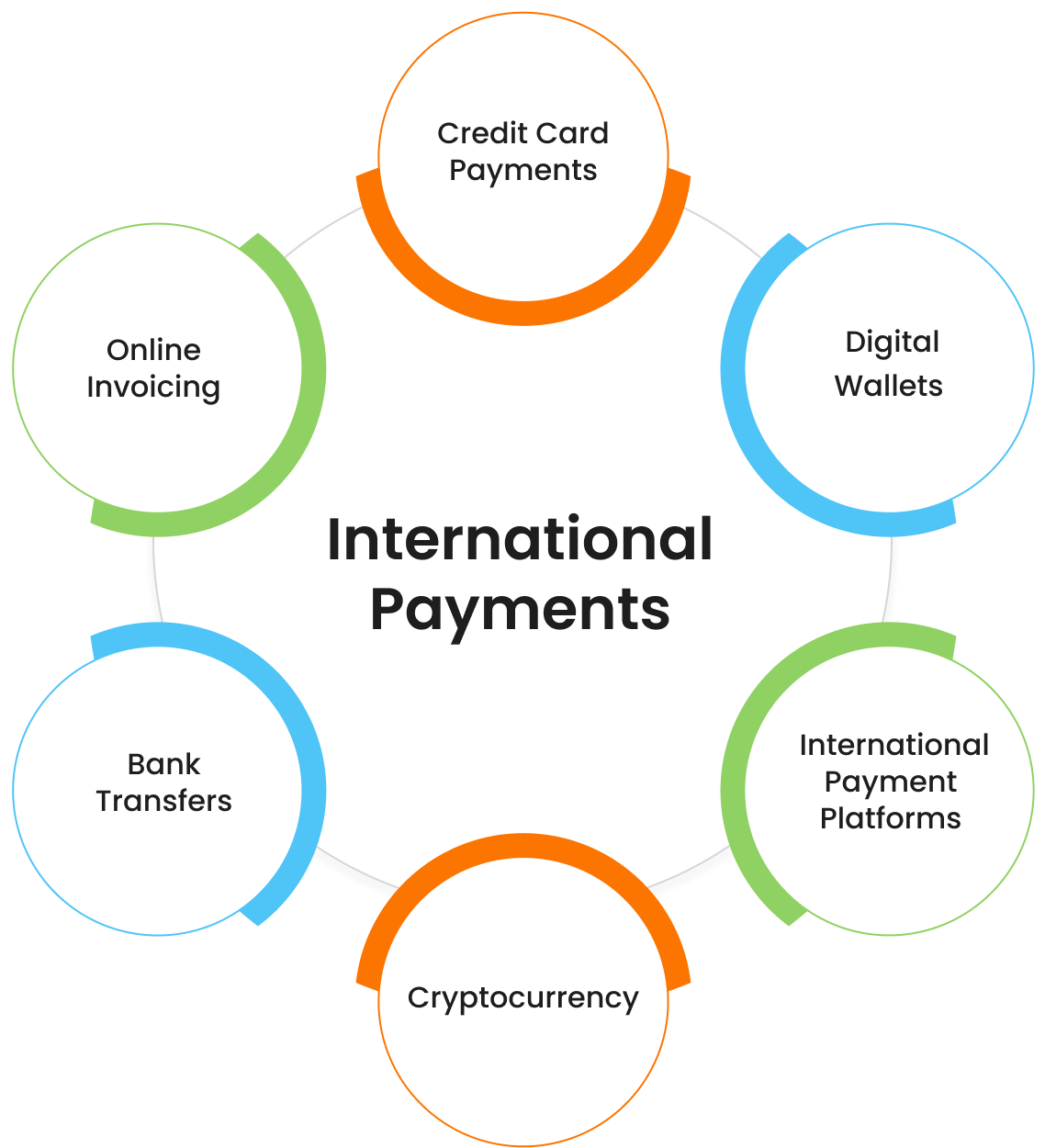
The Four Ways to Get Paid From Another Country
Most businesses end up with more than one collection method, because customers differ. A procurement department in Germany wants an invoice and a bank transfer. A small client in Canada wants a payment link and a card receipt. A marketplace wants to pay out to your account on its own schedule.
The four practical options are:
Bank wire to your account. The customer sends an international transfer in the invoice currency. Simple, credible, and expected by large buyers. Slow, and vulnerable to deductions along the chain.
A local collection account. You hold an account in the customer's currency and receive what looks like a domestic payment. Fast for the customer, but you need a provider that offers virtual accounts, and the money still has to be repatriated.
A payment link or checkout. The customer pays by card, wallet or local method through a hosted page. Excellent conversion for small amounts, expensive for large ones, and exposed to chargebacks.
An invoicing platform. You issue the invoice through a platform that also collects. Good for reconciliation, but you pay for the software and often for the transaction.
There is no universal winner. A consultancy billing fifty thousand dollars per project and a design studio billing two hundred dollars per month need different setups.
Comparing the Options
| Method | Best for | Cost pattern | Settlement speed | Main risk |
|---|---|---|---|---|
| Bank wire | Invoices above ten thousand | Flat fee plus FX margin plus correspondent charges | Several business days | Deductions, address errors, tracing |
| Local collection account | Repeat customers in one currency | Account fee plus conversion spread | Local speed, then repatriation | Provider coverage, repatriation delay |
| Payment link or checkout | Small tickets, fast close | Percentage per transaction plus fixed fee plus FX | Fast authorization, slower payout | Chargebacks, holds, high percentage cost |
| Invoicing platform | B2B with many invoices | Subscription plus transaction fee | Depends on underlying rail | Lock in, reconciliation gaps |
The percentage based options look cheap on a small ticket and become expensive quickly. A three percent fee on a five hundred dollar invoice is fifteen dollars. The same three percent on a fifty thousand dollar invoice is fifteen hundred dollars, which is more than a wire costs by a wide margin.
That is why most businesses route large invoices through bank rails and small ones through checkout.
What Each Option Really Costs
Every method has a visible fee and a hidden one.
Card and wallet payments. The visible fee is a percentage plus a fixed amount. The hidden cost is the currency conversion, usually one to three percent on top, plus the risk of chargebacks. Stripe publishes its pricing by country and method at stripe.com, and the pattern is consistent across processors: the headline rate is only part of the total.
PayPal and similar wallets. Convenient for small clients, expensive for larger ones, and the conversion spread is usually wider than the transaction fee. PayPal publishes its merchant rates at paypal.com. Many businesses offer it as a convenience and quietly absorb the cost.
Bank wires. A flat outgoing fee, a correspondent charge, and an exchange rate margin that is rarely disclosed as a percentage. On a large invoice, the rate margin dominates.
Local collection accounts. Usually the cheapest way to receive in a foreign currency, but you pay for the account and for the conversion when you move the money out.
The correct comparison is the net amount credited to your account, in your operating currency, after every deduction. Anything else is a guess.
Currency Choice: Invoice in Yours or Theirs?
Invoice in the currency your customer budgets in, unless you have a reason not to. A German buyer budgets in euros. A US buyer budgets in dollars. Invoicing them in your currency pushes the conversion onto them, and procurement teams often reject that, or accept it and pay late.
The trade-off is that you carry the exchange rate risk between invoice date and payment date. On a sixty day term, a three percent currency move can wipe out your margin.
Three ways to manage that:
- Invoice in the customer's currency and price the conversion into your rate. Simple, and usually acceptable.
- Invoice in your currency and state the exchange rate basis. Shifts risk to the buyer, and some will refuse.
- Use a forward contract for large invoices. Locks the rate for a future date, usually for a fee. Worth it above a certain size.
For most small exporters, invoicing in the buyer's currency and building a small buffer into the price is the pragmatic choice.
If your overseas commitments include housing rather than trade invoices, our guide to paying rent abroad covers the deposit, guarantor and proof of payment questions that come with a lease.
Holds, Chargebacks and Verification
Getting paid is not the same as keeping the money. Three things can reverse a payment after it lands.
Chargebacks. A card payment can be disputed for up to several months. If you cannot prove delivery, the money is taken back. Keep delivery evidence, signed contracts and communication records for every card payment.
Payment holds. Processors hold funds when a new account suddenly receives high volume, when the customer's location does not match the usual pattern, or when the industry carries higher risk. A hold is not a loss, but it can last weeks and it damages cash flow.
Compliance reviews. Banks and platforms ask for invoices, contracts and proof of business activity. A payment that arrives without a matching document can be frozen while the sender's bank investigates.
The defence is boring and effective: verify customers before the first payment, keep documents for every transaction, and never accept a payment from a third party who is not on the invoice.
Getting Paid Is Half the Job: Paying Out
The money that arrives has to leave again. Salaries, suppliers, contractors, refunds and taxes all sit on the other side of the same cash cycle. A business that collects efficiently but pays out slowly still runs short of working capital.
The outbound side is where many small exporters lose the margin they fought for on the inbound side. A supplier payment routed through a slow wire with an unclear rate can cost more than the fee saved on collection.
DapsyPay handles the outbound leg for businesses that pay suppliers, contractors or service providers abroad. Payments run on conventional rails such as SEPA and ACH, there are no transfer limits, bulk payments are supported, and the amount the beneficiary receives is clear before you confirm. That makes the full cycle predictable: you know what the customer paid, what the supplier received, and what the difference actually was.
If you extend credit to customers, our guide to the cost of invoice financing explains how to price the gap between invoice and cash.
Building a Simple Collections Process
A process beats a clever payment method.
1. Qualify the customer before the first invoice. Company registration, address, a video call, a reference. Fraudulent orders are cheaper to refuse than to recover. 2. Issue one invoice format. Invoice number, purchase order reference, currency, payment terms, bank details and a payment link for small amounts. 3. State the payer name. Ask the customer to pay from an account in the invoiced company's name. Third party payments trigger reviews. 4. Send reminders on a schedule. Three days before due, on the due date, seven days after. Automated reminders shorten the collection cycle more than any financing facility. 5. Reconcile weekly. Match every receipt to an invoice. Unmatched receipts become disputes. 6. Keep a refund policy in writing. Chargeback disputes are decided on documentation, not on intent.
If you also pay suppliers across borders regularly, the corridor guide to sending money internationally from India shows how documentation and purpose codes affect the outbound side.
Common Mistakes
- Offering every payment method to every customer and reconciling none of them properly.
- Absorbing card fees on large invoices because the checkout was already set up.
- Invoicing in a currency the customer cannot easily pay.
- Accepting payment from a company that is not the invoiced entity.
- Failing to keep delivery evidence, then losing a chargeback.
- Treating a payment hold as a permanent loss and panicking, instead of supplying documents immediately.
- Ignoring the payout side of the cycle when calculating margin.
Frequently Asked Questions
Conclusion
Accepting international payments is a design decision, not a feature you switch on. Match the method to the customer and the ticket size, price the conversion honestly, and document every transaction.
Then look at the other half of the cycle. The margin you protect on collection is only real if the outbound payment does not give it back. A predictable payout process, on conventional rails with clear pricing and no limits, is what turns international revenue into cash you can actually use.
Where a payment cannot be recalled after confirmation, the checks in our guide to moving funds safely between digital accounts apply just as much as they do to a bank transfer.
Move Money Abroad Without the Usual Friction
Fast payments on conventional rails such as SEPA and ACH. No limits, transparent fees, and bulk sending built for business owners.
Visit dapsypay.com