
Quick Answer
What a Proforma Invoice Is, and What It Is Not
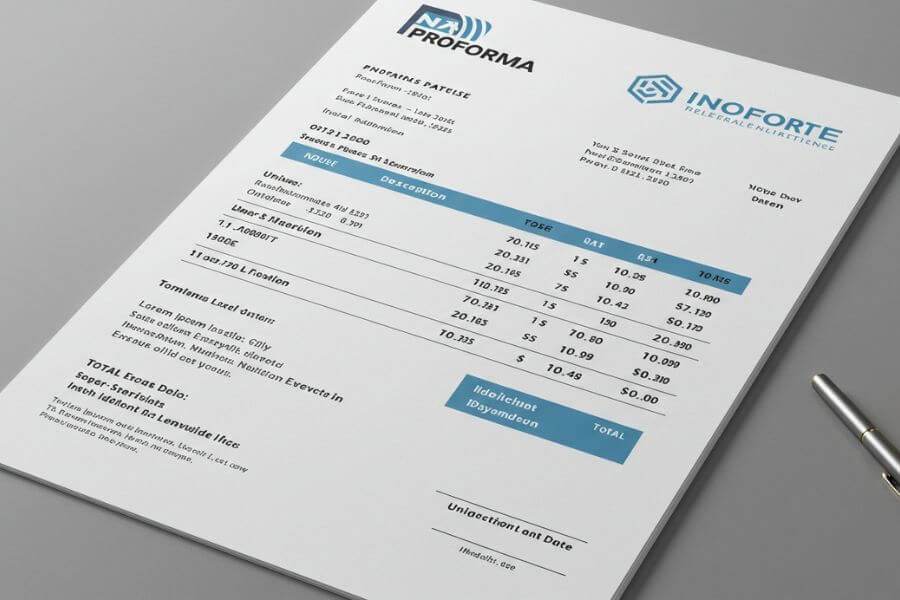
A proforma invoice looks like an invoice because it carries the same commercial facts. The similarity is deliberate. The purpose is different.
It is issued before the transaction is final. It tells the buyer what the order will cost and on what terms, so the buyer can approve the spend internally, apply for foreign exchange, open a letter of credit or present the document to customs. Once the order is confirmed and the goods are shipped, the seller issues a commercial invoice, which is the accounting and customs document that actually demands payment.
Three documents are often confused:
| Document | Purpose | Binding? | Used for |
|---|---|---|---|
| Quotation | Offers a price, often with options | Usually not binding until accepted | Sales discussion and budgeting |
| Proforma invoice | Confirms the intended supply and terms | Confirmed when the buyer accepts and pays according to terms | Order approval, LC opening, import declaration, deposit payment |
| Commercial invoice | Demands payment for goods shipped | Binding | Customs valuation, accounting, tax, payment |
A proforma invoice is not a tax document. It should not be used to claim input tax, and it should not be numbered in a way that collides with the commercial invoice series. Many sellers use a distinct prefix, such as PI, to keep the two sequences separate.
The Fields That Must Be on the Document
A proforma invoice that omits a field will be queried, either by the buyer's bank, the buyer's customs authority or the seller's own finance team. The complete set is short.
| Section | What to include |
|---|---|
| Seller details | Registered business name, address, tax or registration number, contact details |
| Buyer details | Registered name, address, tax or importer number, contact person |
| Document identity | The words Proforma Invoice, a unique number and the issue date |
| Validity | The date until which the price and terms hold |
| Goods description | Clear product name, model or specification, and the HS code for each line |
| Quantity and price | Units, unit price, line total and the invoice total |
| Currency | One currency, stated explicitly, matching the payment instruction |
| Incoterm | The three letter rule and the named place, for example FOB Shanghai |
| Payment terms | Deposit percentage, balance timing, and the method accepted |
| Delivery | Lead time, shipment date and expected arrival window |
| Bank details | Account name, account number, bank name, SWIFT or IBAN, and the currency of the account |
| Origin and weight | Country of origin, gross and net weight, and package count where relevant |
| Signature | A named signatory and a company stamp where customary |
Two fields cause more delay than the rest. The HS code decides duty and, in some markets, whether the goods may be imported at all. The Incoterm decides who pays freight, insurance and import clearance, and therefore what the landed cost actually is.
How to Create One, Step by Step
- Collect the buyer's exact legal details. The name on the proforma must match the name that will appear on the letter of credit, the import declaration and the bank transfer. A trading name that differs from the registered entity creates a mismatch later.
- Assign a unique number and date. Use a series that cannot be confused with commercial invoices, and record it in your sales system.
- Describe each item precisely. Include the model, specification, material, size and HS code. "Spare parts" is not a description. "Hydraulic pump, part number HP 220, cast iron, 15 kg" is.
- Price each line and total the invoice. Keep one currency throughout. If you quote in one currency and expect payment in another, state the conversion basis.
- Choose the Incoterm and name the place. The rule without a place is incomplete. FOB Shanghai and FOB any port are not the same offer.
- State the payment terms. For example, 30 percent deposit on order and 70 percent against the bill of lading, or full payment before shipment. Say which bank charges each side bears.
- Add the bank details and the account currency. The beneficiary name must match the seller's legal name exactly.
- Set a validity date. Prices move with commodity and freight costs, and an open ended proforma becomes a liability.
- Add the delivery timeline. State the lead time from deposit receipt, not from the enquiry date.
- Review against the buyer's requirements, then send a PDF. A PDF preserves the layout and prevents silent edits. Keep the editable version in your own records.
Choosing the Right Incoterm
Incoterms are published by the International Chamber of Commerce and define who arranges and pays for each stage of the journey. The 2020 edition is the current standard. For most small and mid sized importers, four rules cover the majority of orders.
| Incoterm | Seller pays | Buyer pays | Best used when |
|---|---|---|---|
| EXW (Ex Works) | Packing only, at the seller's premises | All transport, export clearance, insurance, import duty | The buyer has a strong forwarder and wants full control |
| FOB (Free On Board) | Transport to the named port and export clearance | Ocean freight, insurance, import clearance | The buyer wants to control freight and insurance |
| CIF (Cost, Insurance, Freight) | Freight and insurance to the named destination port | Import clearance and duty | The buyer wants a simple delivered to port price |
| DDP (Delivered Duty Paid) | Everything, including import duty | Nothing beyond the agreed price | The seller has a customs presence in the destination market |
The commercial risk sits in the gap between the rule and the place. A CIF price to a port is not a delivered price to a warehouse. Importers who budget only the CIF figure discover the duty, terminal handling and inland transport later, and the landed cost turns out to be materially higher than the approved order value.
Payment Terms and the Deposit
A proforma invoice usually becomes the basis for a deposit. That makes two things important: the percentage and the protection.
A common structure is 30 percent on order and 70 percent against shipping documents. Another is a deposit followed by a balance before shipment. Both are normal. What matters is that the proforma states the trigger for each payment and what document the buyer will receive at that point.
The deposit should be paid to the seller's registered business account, with the beneficiary name matching the proforma exactly. A request to pay a different company, a personal account or a newly opened account is a fraud signal, even when the explanation sounds reasonable. Verify a change of bank details by a second channel, using a phone number you already hold rather than the one in the email.
Where Proforma Invoices Cause Problems
Most disputes about proforma invoices are documentary rather than commercial.
- Using it as a tax invoice. A proforma cannot support a tax claim or a formal demand for payment.
- Reusing the number. A duplicate proforma number creates an audit trail that cannot be reconciled.
- Missing validity date. The buyer pays at an old price, or the seller refuses to honour it, and the relationship starts with a dispute.
- Incoterm without a place. The cost allocation becomes arguable.
- Wrong HS code. Duty is assessed on the code, and a correction after shipment is slow and expensive.
- Currency mismatch. The proforma is in dollars, the bank account is in euros, and the payment arrives short after conversion.
- Beneficiary name mismatch. The bank queries the payment, and the deposit is delayed.
- Vague description. Customs cannot classify the goods, so the shipment sits while documents are corrected.
The pattern is consistent. A proforma is a summary, and every later document, from the letter of credit to the customs entry, is checked against it. Accuracy at this stage is cheaper than correction at any later one.
Paying Against a Proforma Without Losing Time
Once the proforma is agreed, the buyer has to move money. That is where a clean document meets a practical constraint: many retail transfer products are not built for a supplier deposit, and the payment can arrive short, arrive late or arrive with a reference the seller cannot match.
This is where DapsyPay fits for business buyers. The platform runs on conventional international rails such as SEPA and ACH rather than on card networks or informal channels, so the deposit lands in the supplier's bank account and appears on a statement that the seller's finance team can reconcile. There are no limits built around the size of the payment, which matters when a production deposit or a balance payment is larger than a consumer product will process in one instruction. Bulk runs are handled as a batch, so several supplier invoices can be settled in one controlled set rather than one at a time, and the fee is shown before the payment is confirmed instead of being absorbed into the exchange rate.
For the buyer, the documentary benefit is direct. A payment made through DapsyPay produces a confirmation that can be filed next to the proforma and the commercial invoice, so the three records reconcile when the goods arrive and the customs entry is lodged.
The reference material is public and worth reading before a first order. The International Chamber of Commerce publishes the Incoterms rules and the guidance that explains each one. The International Trade Administration explains how proforma invoices are used in export transactions and what banks expect to see. The WTO tariff database shows how the HS code drives duty across markets. Each source explains part of the framework. None of them moves a deposit to a supplier or reconciles the payment against the invoice. That is the operational part a conventional-rail platform handles, with no amount limits and a fee shown before confirmation.
A Simple Quality Check Before You Send
Before the proforma leaves your desk, run through five questions.
- Does every name match the buyer's legal registration and the bank account you expect to be paid from?
- Does every line have a quantity, a unit price, a total and an HS code?
- Is there exactly one currency, and does it match the bank account currency?
- Is the Incoterm complete with a named place, and does the payment term state the trigger for each instalment?
- Is there a validity date and a named signatory?
If all five are answered, the document will survive the buyer's bank, the freight forwarder and the customs broker without a rewrite.
Common Mistakes
- Treating the proforma as a contract. It records terms; the sales contract governs the relationship.
- Leaving the validity open. Prices and freight move, and an open ended offer is a commercial risk.
- Quoting a Incoterm without a place. The cost split becomes ambiguous.
- Forgetting the HS code. Duty and admissibility both depend on it.
- Using the seller's trading name on the invoice and the legal name on the bank account. The payment will be queried.
- Not stating who pays bank charges. The recipient can receive less than the invoice value.
- Sending an editable file. A PDF prevents silent changes and keeps the record clean.
FAQ
Conclusion
A proforma invoice is a small document with a large job. It carries the commercial facts that the buyer's bank, the freight forwarder and the customs authority will all rely on, and it becomes the reference against which the commercial invoice and the payment are checked. The fields are not complicated, but each one has a consequence.
Get the names, the HS codes, the Incoterm and the currency right, state the validity and the payment triggers, and keep the bank details consistent with the legal entity. Then the document does what it is supposed to do: it moves the order forward without a rewrite, and it gives the payment a record that reconciles.
Related Guides
- What Documents Do You Need for a Large International Transfer
- How to Buy Property in Turkey
- How to Fill CBN Form A for School Fees
Pay the Proforma Without a Shortfall
Settle supplier deposits and balances on conventional rails with no limits, bulk handling and the fee shown before the payment is confirmed.
Visit dapsypay.com