
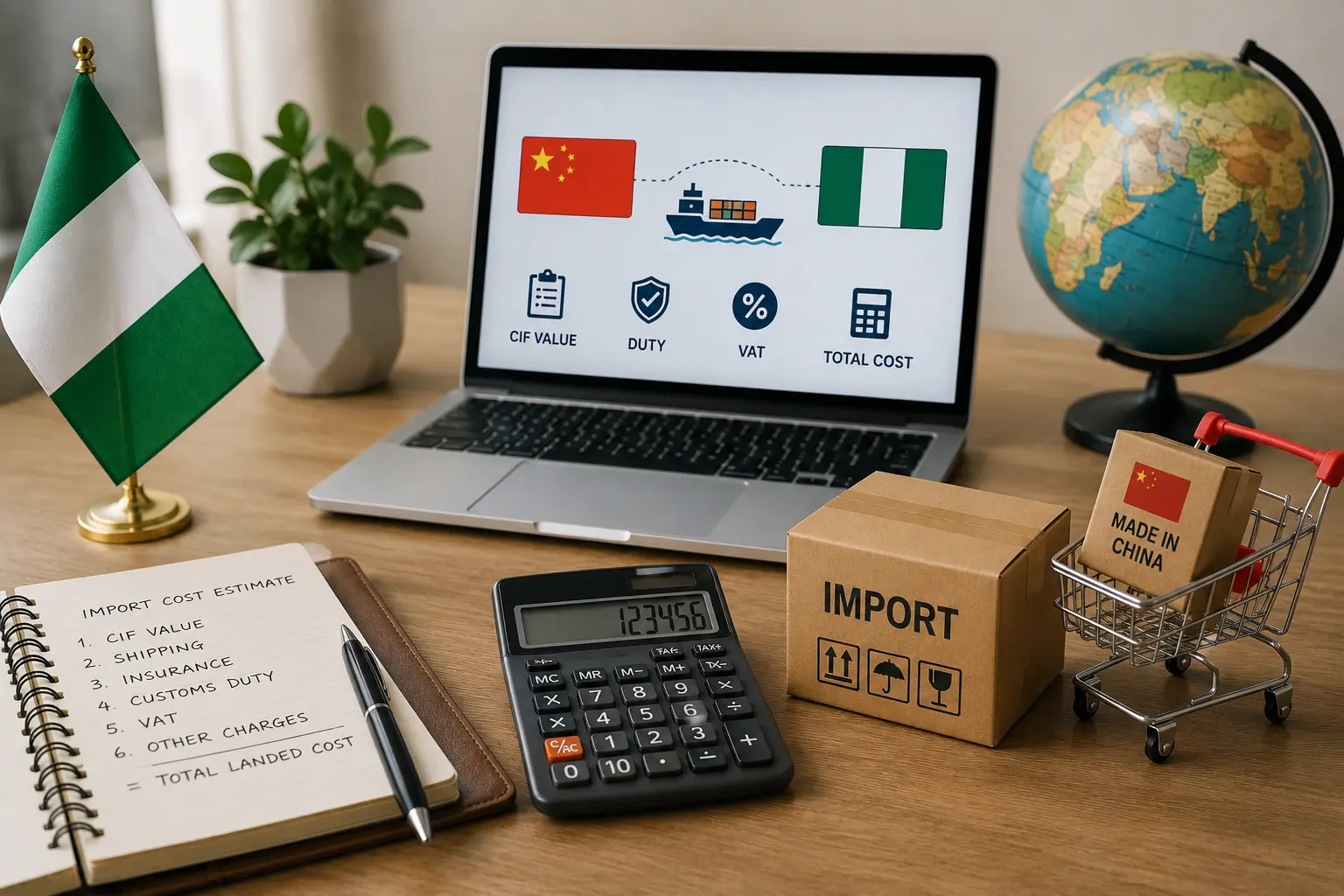
How to Import Goods From China: Sourcing, Shipping, Customs, and Landed Cost
Importing goods from China follows a predictable sequence: choose a product that clears your local rules, shortlist and verify suppliers, order samples, agree a price on a clear Incoterm, place a deposit, arrange inspection, choose a shipping method, clear customs, and settle the balance. The number that decides whether the business works is landed cost, not the factory price: unit cost plus freight, insurance, duty, clearing, and inland delivery.
Start With the Product, Not the Supplier
Most first-time importers open a marketplace and start messaging factories. That order is backwards. The product decision determines everything else, including whether you can import it at all.
Before sourcing anything, confirm four things.
- Is the product allowed? Some goods are restricted, require permits, or carry standards certification before they can be cleared.
- What is the duty band? Duty rates vary widely by category, and a product with a thin margin can be wiped out by the wrong tariff code.
- Is there a market where you are selling? Importing a container is easy. Selling it is the actual business.
- What is your realistic order size? Factories price per unit, but minimum order quantities decide how much cash you need up front.
Write these numbers down before contacting a single supplier. Importers who skip this step often discover their unit economics do not work only after the goods are already on a vessel.
How to Find and Verify Suppliers in China
There are three main channels, and most importers use a combination.
- Marketplace listings. Large B2B marketplaces give you the widest first look at factories and trading companies.
- Trade shows and industry directories. Slower, but the quality of contact is usually higher.
- A sourcing agent. Useful when you need factory-level pricing, inspection, and consolidation of several suppliers.
Large B2B marketplaces are still the fastest first look at factories, and Alibaba remains the largest of them for most importers. Treat a marketplace as a directory rather than as verification. The platform confirms that a supplier has an account, not that the company behind it will deliver, so the licence, the factory, and the bank account still have to be checked by you.
The critical distinction is between a factory and a trading company. Both can be legitimate, but the price and the control differ. A trading company adds margin and often handles export paperwork well. A factory can offer better unit pricing but may be less flexible on small orders.
Verification checks that actually matter
- Business licence and registered name. Ask for the licence and confirm the company name matches the bank account you are asked to pay.
- Factory address and a live video walkthrough. A short video call inside the production floor tells you more than a photo gallery.
- Export history and existing customers. Ask which markets they already ship to, and in what volumes.
- Certification for your category. Electrical goods, toys, food contact items, and cosmetics carry specific testing requirements.
- Bank account in the company name. This single check prevents a large share of payment fraud.
If the bank account name does not match the supplier's registered company name, stop and ask why. Legitimate suppliers can explain. Fraudsters usually cannot.
Samples, Specifications, and the Paper Trail
A sample order is not a formality. It is the cheapest quality control you will ever buy.
Order a paid sample, not a free one, and ask for the exact specification in writing: materials, dimensions, tolerances, packaging, and labelling. Keep that document. It becomes the reference against which the production run is checked, and it is the evidence you need if the goods arrive different from what was agreed.
When the sample arrives, test it the way your customer will. Then confirm the production specification in writing before paying a deposit. Verbal agreements are worth very little once money has left your account.
Incoterms: Who Pays for What
Incoterms are the three or four letter terms that decide where the supplier's responsibility ends. Getting them wrong is one of the most expensive mistakes in importing.
| Incoterm | Supplier handles | You handle | Best for |
|---|---|---|---|
| EXW | Packing at the factory | Everything from pickup onwards | Experienced importers with their own forwarder |
| FOB | Delivery to the port of loading | Freight, insurance, duty, clearing | Most first-time importers |
| CIF | Freight and insurance to your port | Duty, clearing, inland delivery | Simple quotes on sea freight |
| DDP | Everything, including duty, to your door | Nothing beyond the invoice | Small parcels and where you want one fixed price |
FOB is the most common starting point because it gives you control of freight and a clear view of the cost breakdown. DDP looks simple, but the duty is buried inside the price, so you never learn what the goods really cost to land.
Choosing a Shipping Method
The choice between sea, air, and express freight is a trade-off between cost, speed, and volume.
- Sea freight. Lowest cost per unit, longest transit, best for bulky or heavy goods. Full container loads suit larger orders, and shared container space suits smaller ones.
- Air freight. Faster than sea, more expensive, best for high value, low weight, or time-sensitive goods.
- Express courier. Fastest and most expensive per kilo, best for samples and small parcels.
A practical rule: if the freight cost per unit is more than a small fraction of the product cost, the product is probably too heavy or too cheap to import profitably by air. Freight is not a detail. It is a line in your unit economics.
Customs Clearance and Duty
Customs is where importers lose money quietly. Two shipments of the same goods can attract different treatment if the documentation differs.
The tariff code determines the duty rate, and the customs value determines the base it is applied to. In most jurisdictions the customs value is the transaction value plus freight and insurance, which means your shipping cost affects your duty.
Most importers hit at least one of these problems on their first shipment.
- Wrong tariff classification. The most common and most expensive error.
- Missing permits or certificates. A shipment can sit at the port until paperwork is produced.
- Under-declared value. A serious risk that leads to penalties and holds.
- Incomplete commercial invoice. Missing descriptions, quantities, or terms slow clearance.
Clearance times vary widely between countries, and that variability is the reason a payment schedule needs a buffer. The World Bank publishes logistics and trade cost data, including the Logistics Performance Index, which shows how much clearance and delivery times differ across markets. Read it before promising a delivery date, and keep the final supplier payment on a route that will not add days of its own.
Nigeria Customs Service publishes the procedures and documentation requirements that apply to imports into Nigeria, and reading them before the shipment sails is far cheaper than learning them at the port. Nigeria Customs Service sets out those requirements for importers, and the detail matters because a single missing document can hold a container for days. A supplier payment sent on fast conventional rails with the fee disclosed up front keeps the balance payment off that critical path.
Calculating Landed Cost Properly
Landed cost is the only number that tells you whether an import makes money. Build it as a table before you order.
| Cost line | What to include |
|---|---|
| Unit cost | Factory price per unit |
| Freight | Sea, air, or courier, allocated per unit |
| Insurance | Typically a small percentage of goods value |
| Duty and taxes | Based on tariff code and customs value |
| Clearing and port charges | Agent fees, storage, terminal charges |
| Inland delivery | Transport from port to your warehouse |
| Damage and shrinkage | A realistic allowance, not zero |
Add a margin for exchange rate movement. If your supplier invoices in dollars and your revenue is in naira, a rate move between deposit and balance can quietly remove your profit.
Paying an Overseas Supplier Without Delays
Payment structure matters as much as price. The standard arrangement is a deposit before production and a balance before shipment, and both payments sit on a deadline. Delay the deposit and your production slot moves. Delay the balance and your goods sit in a warehouse accruing storage.
This is where a card payment or an informal route tends to break down, because supply payments are larger than the limits those instruments are built for. DapsyPay is built for exactly this kind of outbound payment: transfers on conventional international rails such as SEPA and ACH, no limits that interrupt a large supplier payment, and a fee and exchange rate that are shown before you confirm.
The practical benefit for importers is that the payment stops being the weak link. Deposits, milestone payments, freight invoices, and clearing charges can all be settled into the supplier's bank account, and the platform is designed for bulk sending, which suits importers paying several factories and forwarders in the same month.
Two related reads are worth your time. Our guide to how international payment systems work explains the rails behind the payment, and why virtual dollar cards get declined covers the failures that hit importers who rely on cards for supplier deposits. If you travel to visit a factory or a trade show, our guide to how much money you can take overseas covers the cash rules, and readers comparing account and verification options will find a separate view in our guide to verification and account safety.
Common Mistakes First-Time Importers Make
- Ordering before checking the duty band. A thin margin disappears at the port.
- Paying a supplier whose bank account name does not match the company. The single most expensive shortcut.
- Skipping the paid sample. Cheap up front, expensive later.
- Choosing the cheapest freight quote without checking transit and handling. Late goods cost more than the freight saved.
- Forgetting clearing and storage in the cost model. Port charges are not small.
- Leaving no buffer for exchange rate movement. Rates move between deposit and balance.
- Failing to inspect before shipment. Fixing defects after arrival is rarely possible.
Frequently Asked Questions
Conclusion
Importing goods from China is a process, not a gamble. Verify the supplier, define the specification, choose an Incoterm you understand, build a landed cost model, and arrange shipping and clearing before the goods leave the factory.
The part most importers underplan is the money movement between all of those steps. A supplier payment that arrives late can move a production slot, miss a vessel, or leave goods sitting at a port. Putting that payment on a route designed for fast, unlimited, business-scale transfers removes a risk that costs far more than the fee it saves.
Fund an Import Without Payment Delays
Settle deposits, balances and freight invoices with the rate and fee shown up front, on rails built for bulk business sending.
Visit dapsypay.com