
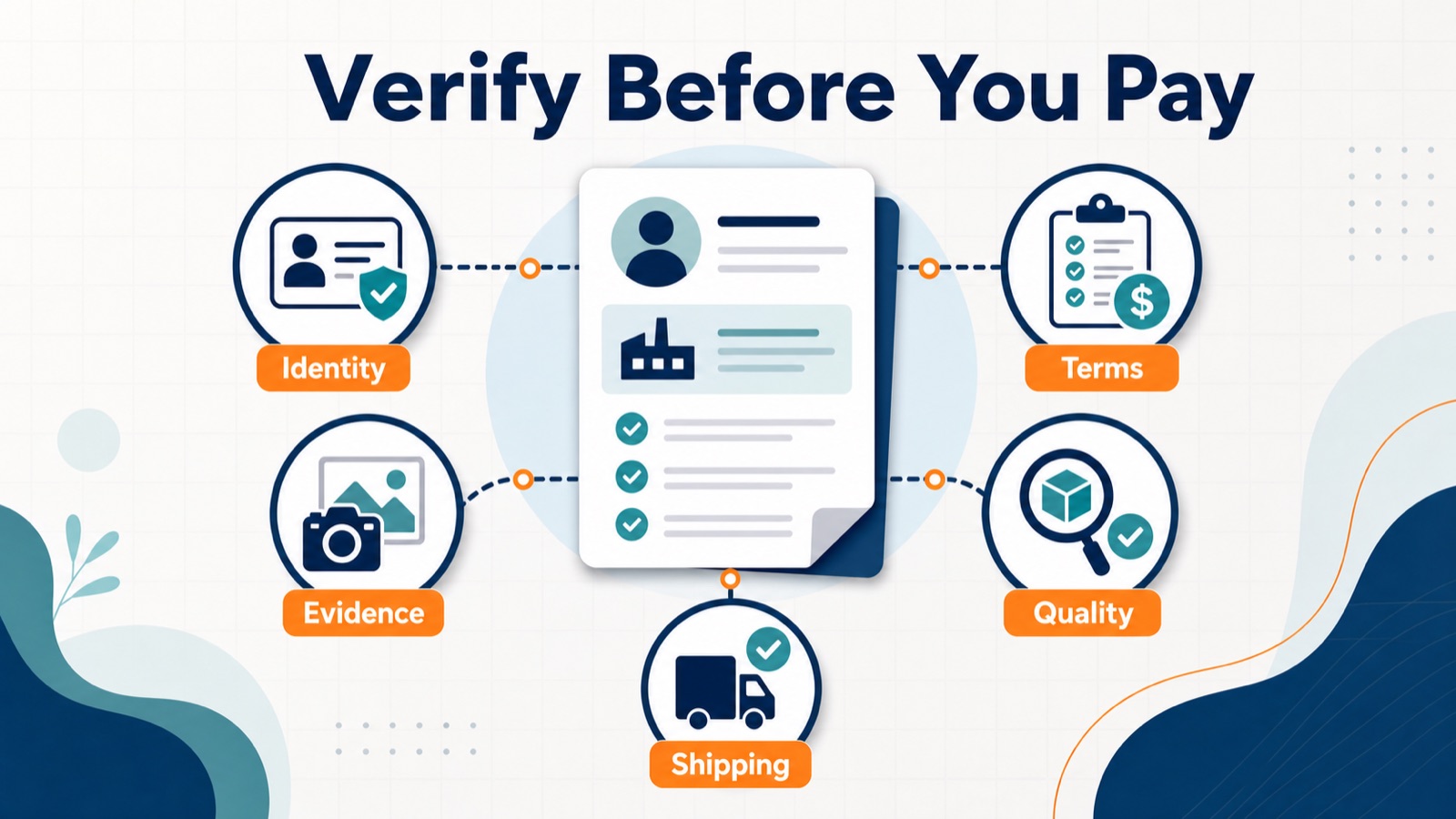
How to Verify a Supplier Before You Pay a Deposit
A deposit is the moment a supplier relationship becomes real. Until then, you are two parties exchanging messages. Once money leaves your account, you are exposed. Most importers who lose money do not lose it to a clever hack. They lose it because they skipped a handful of checks that would have taken an afternoon.
This guide walks through those checks in the order that matters, explains what a genuine supplier can actually prove, and shows how to structure the payment itself so a deposit stays a calculated risk rather than a leap of faith.
Why the Deposit Is the Risk Point
A deposit is a bet on future behaviour. You pay before you have goods, and the supplier ships after the money lands. That gap is unavoidable in international trade, because factories rarely produce without funding for materials.
What you can control is how much you trust the other side before that gap opens. Verification reduces the chance that you are paying a real factory at all. Payment structure limits the damage if something still goes wrong. The two work together, which is why this article treats them as one process.
What a Genuine Supplier Can Prove
A legitimate trading company, factory, or distributor can normally provide, without hesitation:
- A business registration number and the registered company name
- A physical address, not just a chat account
- A named contact with a role inside the company
- Trade references from existing buyers, ideally in your region
- Product documentation, testing reports, and export history
- A bank account held in the company name, in a consistent jurisdiction
Notice the pattern. Every item is a fact that can be checked from a source outside the supplier's own chat messages. That is the whole point. Claims are easy. Verification means confirming the claim somewhere the supplier does not control.
How to Verify a Supplier Step by Step
Step 1: Check the Business Registration
Ask for the registration number, then look it up. Registries are public in most major markets. In the United Kingdom you can search a company's filing history and directors free of charge through the official Companies House register. China has the National Enterprise Credit Information Publicity System, and most other jurisdictions publish equivalent records.
Check three things: that the company exists, that it is active rather than struck off, and that the name matches the person and account you are being asked to pay. A supplier who resists this is telling you something.
Step 2: Confirm You Are Dealing With the Company, Not a Reseller
Many sellers on large marketplaces are trading companies, not manufacturers. That is not automatically bad. A good trading company bundles several factories, handles quality control, and takes a margin for the work. The problem is when someone claims to be a factory to justify a factory-level price.
Ask a small, specific question that a factory would answer instantly: how many production lines do you run, what is your monthly capacity, which port do you ship from. Trading companies answer vaguely. Factories answer in numbers.
Step 3: Call the Trade References
References only mean something if you contact them yourself. Ask for two or three existing buyers, then reach out through your own channels. If the supplier insists on handling the introduction and staying on the call, treat the reference as unverified.
The International Chamber of Commerce publishes commercial crime guidance that repeatedly flags fabricated references as an early stage in trade fraud. The pattern is old and predictable: a slick reference list, a deposit request, then silence.
Step 4: Ask for a Live Walkthrough
A recorded factory tour can be filmed anywhere. A live video call, at a time you choose rather than a time they propose, is much harder to fake. Ask to see production, packing, and the stock that is supposedly reserved for your order. Ask the camera to move, not just pan across a tidy showroom.
Step 5: Pay for a Sample Before a Bulk Deposit
A sample order is the cheapest due diligence available. It tests product quality, packaging, labelling, communication, and shipping speed all at once. It also tests the supplier's patience. A factory that refuses a paid sample order is usually protecting a gap between what it advertises and what it can produce.
Step 6: Match the Bank Account to the Company Name
This is the check that stops the most money from disappearing. The account name must match the registered company name you verified in Step 1. If the supplier asks you to pay a personal account, a different company, or a "sister company" in a third country, stop and ask questions in writing.
Fraudsters who hijack an email thread often change only the bank details, keeping everything else identical. Confirming the account by voice, on a phone number you already had, defeats most of that.
Red Flags That Should Stop a Deposit
- Pressure to pay today, with a price that expires in hours
- A bank account in a country unrelated to the business
- Refusal to provide a registration number or references
- Communication that shifts suddenly to a new email address with changed bank details
- Prices far below every other quote for the same specification
- A supplier who cannot describe their own production process
Any single flag might have an innocent explanation. Two together usually means walk away.
Structuring the Payment So You Keep Leverage
Verification tells you who you are dealing with. Payment structure decides what happens next. A workable pattern for a first order is a modest deposit, a balance against inspection, and a final instalment on agreed shipping documents.
| Stage | Typical share | Trigger |
|---|---|---|
| Deposit | 20 to 30 percent | Order confirmation |
| Balance | 50 to 60 percent | Inspection or pre-shipment photos |
| Final | 10 to 20 percent | Documents or arrival |
This is also where the rail you use matters. A deposit should move through a traceable, bank-level channel that keeps a complete record of who sent, who received, and when. DapsyPay runs on conventional international rails such as SEPA and ACH, so business buyers get fast, dependable transfers with no limits, transparent fees, and direct delivery to the supplier's own bank account. That combination matters when you are paying staged instalments to a factory you have just met, because a clear audit trail is what protects you if a payment is ever disputed.
If you are building this into a wider sourcing process, the same discipline applies when you file a Trade Assurance claim, and it is worth understanding how international parcel and freight routing works before goods leave the factory. Buyers who also study how business FX providers price currency tend to negotiate better, and anyone moving money across borders should understand how modern cross-border settlement works.
Common Mistakes Buyers Make
- Verifying the product and forgetting to verify the company
- Accepting screenshots of documents instead of looking them up
- Paying a personal account because it was faster
- Sending the full amount to unlock a discount
- Ignoring a small inconsistency because the price was good
- Letting one person handle both supplier contact and payment approval
The last one is underrated. Separating the person who talks to the supplier from the person who releases funds makes fraud and mistakes much harder.
Frequently Asked Questions
Conclusion
Verifying a supplier before you pay a deposit is not complicated. It is a short list of checks, done in order, using sources the supplier cannot control. Confirm the registration, talk to references you chose, see the operation live, test with a sample, and match the account name to the company.
Then structure the payment so each instalment is tied to something you can see. Do that, and a deposit becomes a normal cost of doing business rather than a gamble on a stranger.
Pay Suppliers With Confidence
Fast, transparent cross-border payments built for bulk and business sending, with no limits.
Visit dapsypay.com