
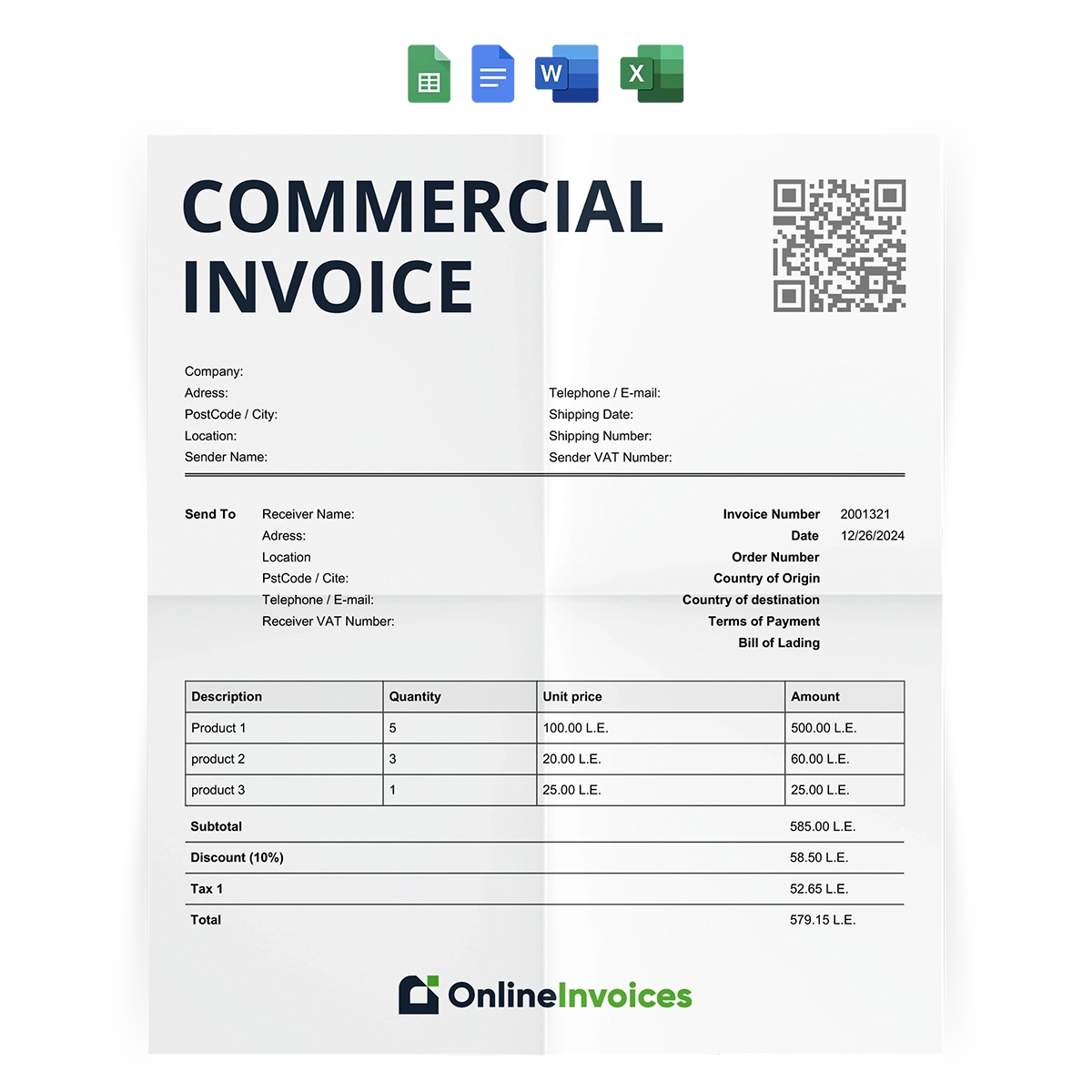
What a Commercial Invoice Is
A commercial invoice is the seller's formal request for payment and the buyer's proof of purchase. In international trade it does two jobs at once. It tells the buyer what they owe and on what terms, and it tells customs what is moving across the border and what it is worth.
That second job is why the document is treated more seriously than a domestic invoice. A domestic invoice can be a simple PDF with a total at the bottom. An export invoice has to survive scrutiny from a customs officer who has never seen the goods, the buyer, or the seller. If the description is vague or the value looks wrong, the shipment can be detained.
The World Customs Organization maintains the Harmonized System that classifies traded goods, and its HS nomenclature guidance explains why a precise product code matters. Customs systems are built around those codes. An invoice without one forces an officer to guess, and guessing usually means the shipment waits.
Why Customs Rely on the Commercial Invoice
Customs authorities assess three things from the invoice: what the goods are, where they came from, and what they are worth. Those three answers determine the duty rate, any preferential treatment under a trade agreement, and the tax base for import VAT or sales tax.
The invoice also supports security and compliance checks. It shows whether the goods are restricted, whether the declared value matches the freight and insurance documents, and whether the buyer and seller are independent parties. A suspiciously low value on a high-value shipment is one of the most common reasons for a customs query.
For the seller, the invoice is also a commercial document. It sets the payment terms, identifies the bank account, and can be assigned to a financier if the seller needs working capital before the buyer pays.
The Fields a Commercial Invoice Must Include
There is no single global template, but most customs authorities expect the same core information. Missing any of these is enough to trigger a query.
| Field | What to write | Why it matters |
|---|---|---|
| Seller details | Full legal name, address, registration or tax number | Identifies the exporter of record |
| Buyer details | Full legal name, address, tax or importer number | Identifies the party responsible for duty |
| Invoice number and date | A unique reference and the issue date | Links the invoice to the shipment and payment |
| Description of goods | Product name, material, use, model or part number | Lets customs classify the goods correctly |
| Quantity and unit | Number of units, weight, or volume | Matches the invoice to the packing list |
| Unit price and total | Price per unit, line totals, invoice total | Forms the basis of the customs value |
| Currency | The currency of the sale, clearly stated | Prevents conversion errors |
| HS or tariff code | The classification code for each product line | Sets the duty rate |
| Country of origin | Where the goods were manufactured | Determines duty and trade agreement eligibility |
| Incoterms | For example FOB, CIF, or DAP, with the named place | Shows who pays freight and insurance |
| Payment terms | Due date, method, and bank details | Tells the buyer how and when to pay |
| Reason for export | Sale, sample, return, or gift | Distinguishes a commercial shipment from other flows |
| Declaration and signature | A statement that the information is true | Makes the document legally meaningful |
The International Chamber of Commerce publishes the Incoterms rules that define those delivery terms. Its Incoterms 2020 overview is the reference customs officers and freight forwarders expect you to use. A platform that handles the payment side, such as DapsyPay, cannot fix a bad invoice, but it can make the payment reference match the invoice cleanly, which reduces the chance of a compliance query on the money itself.
Commercial Invoice vs Proforma Invoice vs Packing List
These three documents are often confused, and using the wrong one creates delays.
| Document | Purpose | When it is used |
|---|---|---|
| Proforma invoice | A quotation and provisional request for payment | Before the sale is confirmed, or to support an import licence or letter of credit |
| Commercial invoice | The final bill for goods that have been sold | With the shipment and with the payment request |
| Packing list | A detailed list of what is inside each package | Alongside the commercial invoice for customs and handling |
A proforma invoice is not a demand for payment in the legal sense, and it should not be used to clear goods. A commercial invoice is the final document. A packing list does not replace either one, because it does not state value or payment terms.
How the Invoice Affects Duty and Tax
Duty is usually calculated on the customs value of the goods, not simply on the price shown at the top of the invoice. Depending on the country, the customs value may include freight and insurance, which is the CIF basis, or may be based on the transaction value alone.
That means the Incoterm on the invoice matters. If you sell on an FOB basis, the freight and insurance may be added by customs before duty is assessed. If you sell on a CIF or DAP basis, those costs are already inside the price. Either way, the invoice and the freight documents must tell the same story.
Import VAT or sales tax is then applied to the customs value plus duty in many jurisdictions. A small error in the declared value therefore multiplies through the tax calculation.
Common Errors That Hold Clearance
- A vague description such as "spare parts" or "electronics" instead of a specific product name and model.
- A missing HS code, or a code that does not match the goods.
- A total that does not equal the sum of the line items.
- Freight and insurance shown inconsistently with the Incoterm.
- The buyer's name differing from the importer of record.
- A currency with no clear conversion basis.
- No country of origin, or an origin that conflicts with the product markings.
- An invoice dated after the shipment when the shipment required pre-clearance.
- Handwritten corrections without a signature or stamp.
Each error is small on its own. Together they turn a routine clearance into a multi-day review.
How to Prepare a Commercial Invoice Step by Step
1. Confirm the sale terms, including the Incoterm and the named place. 2. List every product line with a specific description, model, quantity, and unit price. 3. Assign the correct HS code to each line, checking with a customs broker if the product is unusual. 4. State the country of origin for each line. 5. Calculate the line totals and the invoice total, then check the arithmetic. 6. Add the payment terms, bank details, and a payment reference that the buyer can quote. 7. Add the export declaration and sign the document. 8. Match the invoice to the packing list, the freight documents, and the payment instruction before sending.
A second pair of eyes is worth the time. Most errors are caught by comparing the invoice against the packing list line by line.
Getting the Invoice Paid Across Borders
A correct invoice solves the customs problem. It does not automatically solve the payment problem. International invoices are often paid by bank transfer, and the payment can pass through several institutions before it reaches the seller.
That is where the payment rail matters. A conventional bank wire can take several days and may lose value to intermediary deductions. A card payment is fast but carries small limits and merchant fees that make it unsuitable for a large supplier invoice. A specialist platform can pay directly into a bank account on established rails.
DapsyPay is built for this side of the transaction. It runs on conventional transfer rails such as SEPA and ACH, supports bulk and high-value payments without the small caps common on cards and consumer wallets, and delivers into a bank account with transparent fees. For an importer paying several suppliers from one invoice run, that means fewer transfers and a cleaner audit trail. The invoice reference can be carried through the payment, so the seller can match the funds to the document without emailing to ask what the payment was for.Record Keeping and Compliance
Keep the commercial invoice, packing list, bill of lading or airway bill, proof of payment, and any customs decision together for the period your jurisdiction requires. Most jurisdictions require several years of retention, though the exact period varies.
The records matter for more than an audit. If a duty assessment is questioned later, the invoice is the first document a broker or lawyer will ask for. A complete file also supports VAT recovery and transfer pricing documentation for related-party transactions.
FAQ
Conclusion
A commercial invoice is a commercial document and a customs document at the same time. The businesses that treat it as paperwork tend to be the ones whose shipments sit in clearance. The businesses that treat it as part of the transaction, with clean product descriptions, correct codes, and consistent values, move goods and money with far less friction.
Get the document right, then choose a payment route that carries the same reference and delivers into the beneficiary's bank account without unnecessary intermediaries. DapsyPay is designed for that second step: fast conventional-rail transfers, no small limits, bulk and business sending, and transparent fees from the invoice to the bank account.
Related Reading
For the compliance side of a high-value settlement, read why large international payments get held for review. For corridor guidance, see how to send money to Ghana and how to send money to Kenya. Readers comparing settlement methods can also review our guide to digital payment options for cross-border transfers.
Move Money Across Borders With Confidence
Fast transfers, transparent fees, and direct bank-account delivery built for business.
Visit dapsypay.com