
What Is an IBAN and a BIC Code and How Do You Use Them Correctly
Quick Answer: An IBAN is your beneficiary's full bank account number, including the country code and two check digits. A BIC, also called a SWIFT code, identifies the bank itself. For a payment inside Europe or the Middle East, you usually need both: the IBAN tells the bank which account to credit, and the BIC tells it which institution to route to. For payments to the United States, Canada, Australia, and much of Asia, there is no IBAN, and you use a local account number with a routing or sort code instead.
What an IBAN Is and What It Contains
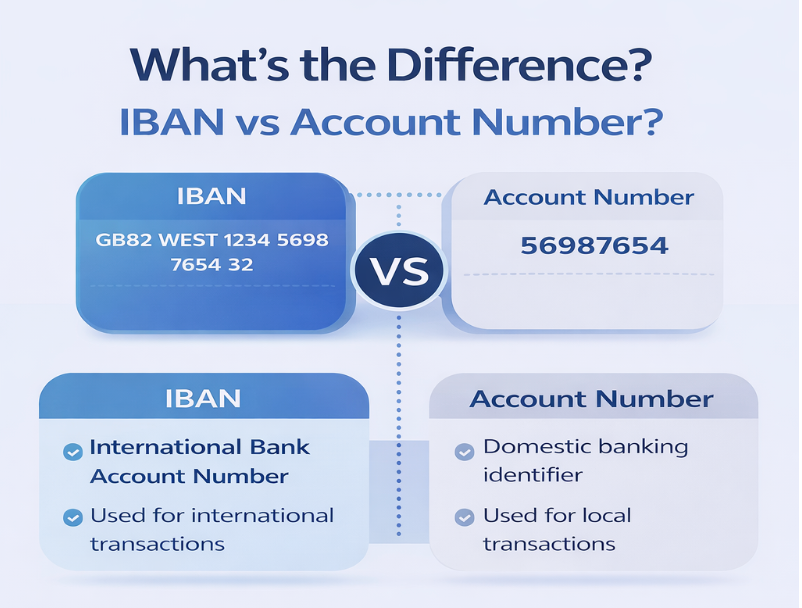
IBAN stands for International Bank Account Number. It was designed so that every account in a participating country could be expressed in one predictable format, which reduces human error and speeds up automated processing.
Its structure is simpler than it looks.
Country code2 lettersWhere the account is held, for example GB or DE Check digits2 digitsA mathematical check that validates the whole number Bank code4 to 8 charactersIdentifies the specific bank and branch Account numberUp to 20 charactersThe customer's account within that bankA worked example:
GB29 NWBK 6016 1331 9268 19
Read it left to right: GB is the country, 29 is the checksum, NWBK identifies the bank and branch, and the remaining characters are the account itself. A German IBAN is 22 characters long, a French one is 27, and a Maltese one is 31. Anything between 15 and 34 characters is possible.
The important consequence is that you never need to know how a foreign IBAN decomposes. You need the whole string, in the right order, without gaps or substituted characters.
What a BIC or SWIFT Code Is
A BIC, short for Business Identifier Code, is an eight or eleven character identifier for a bank. Because the registry that maintains these codes belongs to SWIFT, most people outside banking call it a SWIFT code.
The format is:
- First four characters: the bank, for example NWBK
- Next two characters: the country, for example GB
- Next two characters: the location, for example 2L for London
- Final three characters (optional): a specific branch
So NWBKGB2L and NWBKGB2LXXX are the same institution, with the final block indicating the branch or head office. If you only have eight characters, the bank's head office can usually route the payment.
A BIC does not identify an account. It identifies an institution. Sending a BIC without an IBAN is like addressing a letter to a building without naming the person.
IBAN Countries and What to Use Instead
Roughly 80 countries use IBANs, including the whole SEPA area, the United Kingdom, most of the Middle East, and parts of Africa and the Caribbean. The full official registry is maintained by SWIFT. Many major destinations do not use IBANs at all. In those cases, you send different details:
United StatesAccount number plus ABA routing number, and sometimes a SWIFT code CanadaAccount number plus transit number and institution number AustraliaAccount number plus BSB code IndiaAccount number plus IFSC code Most of Asia and Latin AmericaLocal account number, sometimes with a national clearing codeThis is why two payments of the same size can need completely different information. A bank transfer to a German supplier is an IBAN and BIC exercise. A transfer to a Texas equipment dealer often needs a routing number instead.
How to Enter Payment Details Correctly
Most failed or delayed transfers come down to details, not to money. This checklist prevents the majority of them.
- Ask the supplier for a letterhead invoice. Bank details written in a chat message are easy to mistype and easy to fake.
- Copy and paste rather than typing. IBANs are long, and one wrong character breaks the checksum.
- Check the country code matches the supplier's bank. A German supplier with a Bulgarian IBAN should raise a question.
- Validate the check digits before sending. Many banking apps validate automatically, and standalone IBAN validators are free.
- Confirm the bank name against the BIC. The institution on the invoice should match the institution the code points to.
- Put a clear reference. Invoice number and company name are the minimum. This is what lets the supplier match the money to the order.
- Keep the confirmation. A payment receipt with a reference number is your evidence if something goes wrong.
For routine verification, the European Central Bank publishes reference material on SEPA and payment scheme rules that explains why these formats matter for straight through processing.
What Happens When the Details Are Wrong
Three outcomes are possible, and they are not equally pleasant.
The payment is rejected automatically. Best case. The check digits fail or the bank code is unknown, and the money returns to you after a few business days, minus any fees charged along the way.
The payment lands in the wrong account. Worst case. If a valid IBAN belongs to someone else, the money reaches a stranger, and recovery depends on that person consenting to the return. Banks are not obliged to reverse a correctly instructed payment.
The payment is delayed while someone checks. Common with name mismatches. If the beneficiary name and the account name do not match closely, the receiving bank may hold the payment for clarification, which can add days.
There is also a security angle. Invoice fraud usually works by sending a supplier's customer an updated bank detail. Any change to payment details should be verified by calling a number you already have, never a number supplied in the same message that announced the change.
How Payment Providers Reduce Detail Errors
This is where the choice of payment provider shows up in a practical way. DapsyPay is built for businesses paying abroad, and the platform runs on conventional international rails such as SEPA and ACH. That combination matters for detail accuracy: beneficiary information is captured once, validated against the destination scheme, and reused for repeat payments, so you are not retyping an IBAN every month. Transfers move faster than traditional bank transfers, there are no limits on amount, and funds are paid directly into the recipient's bank account, which removes an intermediary hop where details can be misread. Pricing is transparent and conversions happen at a clear rate, so the figure you send is the figure that arrives.
If you are sending several payments in the same week, it also helps to understand why splitting one large transfer into many small ones can create more problems than it solves, because each extra payment multiplies the chance of a detail error. Importers preparing cargo payments should pair that with the FCL versus LCL shipping comparison to keep the money side and the freight side aligned. And if your next payment is to a factory you are visiting in person, our guide to budgeting a sourcing trip and paying suppliers while you are there covers what to confirm before you leave the meeting room. When the recipient prefers a digital network over a bank account, how long a transfer takes on different networks sets out where the delays actually come from.
Common Mistakes With IBANs and BICs
- Spacing and dashes. Spaces are fine for readability, but never mix letters, numbers, or punctuation into the string itself.
- Using the wrong currency. A payment in pounds to a euro account may convert at a poor rate or bounce entirely.
- Assuming every country has an IBAN. The United States, Canada, and Australia do not, so ask for local details instead.
- Ignoring name mismatches. A beneficiary name that does not match the account can trigger a hold.
- Trusting emailed bank detail changes. Always verify by a second, independent channel.
- Leaving the reference empty. Unreferenced payments are the hardest to trace and reconcile.
Frequently Asked Questions
Conclusion
An IBAN and a BIC do two different jobs. The IBAN points to an account, and the BIC points to a bank. Getting both right, in the right format for the destination country, is the single easiest way to avoid failed, delayed, or misdirected payments.
Businesses that send payments regularly tend to stop thinking about detail formats altogether once beneficiary records are stored and validated. That is the practical benefit of sending through DapsyPay: payments run on standard international rails, reach the recipient's bank account directly, carry no size limits, and settle faster than traditional bank transfers, so the details are captured once and reused every time.
Get Payment Details Right the First Time
Capture beneficiary details once, send on standard international rails, and pay straight into any bank account.
Visit dapsypay.com