
Why SWIFT Wire Transfers Are Slow and How Businesses Speed Them Up
A SWIFT wire transfer is slow because it travels through a chain of correspondent banks, and each bank in that chain reviews, batches, and settles the payment on its own schedule. Most international wires take one to five business days, and a single cut off time missed on a Friday can push delivery into the following week. Businesses speed transfers up by choosing rails that settle directly, keeping payment details exact, batching payments so they leave early in the day, and using a provider that delivers straight into the supplier bank account rather than routing through extra intermediaries.
What Actually Happens After You Press Send
Most people picture an international transfer as one movement of money from one account to another. In reality a wire transfer is a message plus a settlement, and the two travel separately.
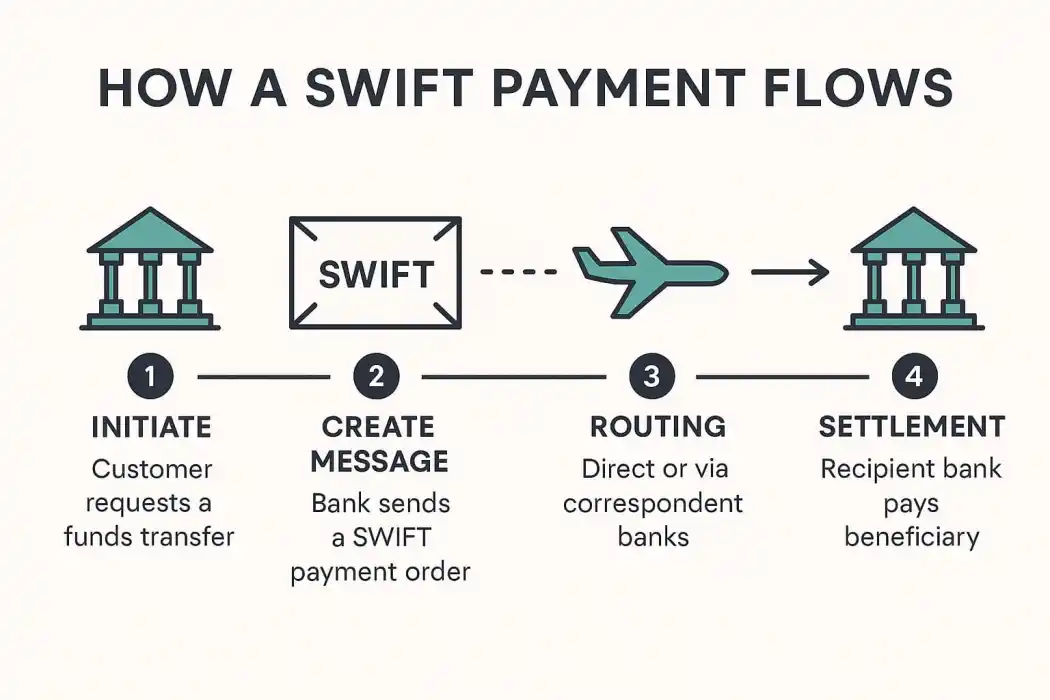
When you send a wire, your bank debits your account and sends a payment instruction across the SWIFT network. SWIFT is a messaging system, not a settlement system, so it does not move the money itself. It delivers the instruction to the receiving bank, and the value is settled afterwards between the banks involved, usually through accounts they hold with each other or with a larger correspondent bank.
That split between message and money is the root of the delay. The instruction can arrive in minutes, while the actual value can arrive days later, because settlement depends on the banks' own processing windows.
The Real Reasons SWIFT Wires Take Days
Several forces work against speed at the same time.
- Correspondent chains. A payment between two countries that do not have a direct banking relationship passes through one or two intermediary banks. Each hop adds its own handling time.
- Cut off times. Banks process outgoing international payments in daily batches. Miss the cut off and the payment waits until the next business day.
- Compliance screening. Every cross-border payment is screened for sanctions, anti money laundering flags, and name mismatches. A screening hold can add a day on its own, and a mismatch can add several.
- Time zones and weekends. A Friday afternoon payment in one country lands in the middle of the weekend for the receiving bank's clearing system.
- Currency conversion steps. If the payment has to be converted between the sender's currency and the receiver's currency, the conversion may happen at an intermediary rather than at the sending bank, adding another processing step.
- Value dating. Some banks credit the customer only once the funds have fully settled, even if the message arrived earlier.
The SWIFT network publishes its own guidance on message flow and processing, and it is clear that the network itself is not the bottleneck. The delays come from the banks and systems at either end, which is why two wires on the same day can arrive a day apart. Compare that with DapsyPay, which runs on conventional transfer rails such as SEPA and ACH, moves payments fast without a correspondent chain slowing every hop, and places no limits on how much you can send in one instruction.
Why Speed Matters More for Business Than for Individuals
For an individual sending money to family, a two day delay is annoying. For a business, it can break a deal.
A supplier who has not been paid does not release goods, and a shipment that waits for funds can miss a vessel, a production window, or a retail season. A deposit that arrives late can hand an order to a competitor. A payroll run that lands after the pay date damages trust with staff and contractors overseas.
Speed also changes how much working capital a business has to hold. Companies that cannot predict when an outgoing payment will leave their account keep a larger cash buffer than they need, and that idle buffer is money not spent on stock or growth. Predictable, fast outgoing payments reduce that buffer requirement directly.
Why the Advertised Wire Fee Is Not the Real Cost
The fee a bank quotes for a wire transfer is only the visible part of the cost.
Sending fee Fixed charge to initiate the wire At the moment you send Intermediary deductions Charges taken by banks in the chain During transit Exchange rate margin Markup inside the conversion rate Inside the rate you are shown Receiving bank fee Charge to accept the deposit On arrival Trace and recall fees Charge to investigate or recall a wire Only when something goes wrongThe exchange rate margin is usually the largest of these, because it scales with the amount rather than sitting flat. A one or two percent margin on a large supplier payment can exceed the visible fee many times over. The Wise pricing pages explain how exchange rate margins work in plain terms, and reading them is a good way to calibrate what a fair all in cost looks like. The practical edge with DapsyPay is that the rate and fee are shown before you confirm, there is no hidden FX markup stacked on top, and the money is delivered directly into the receiving bank account rather than being shaved by intermediaries along the way.
Faster Rails Businesses Use Instead of a Plain SWIFT Wire
Speed mostly comes from picking a route that avoids unnecessary hops.
- SEPA for euro payments. Payments inside the euro area settle on the same or next business day and are treated as domestic once they cross the border.
- ACH for dollar payments. Domestic and, increasingly, cross-border dollar payments move through automated clearing, which is cheaper and faster than a correspondent wire.
- Local rails in the destination country. Paying out through the recipient country's own clearing system is often the quickest way to reach a supplier's bank account.
- Direct provider relationships. A payment platform with its own banking relationships can send and receive without the extra intermediary that a small bank has to use.
- Batched instructions. Sending several payments in one batch with a single settlement instruction removes repeated cut off exposure.
The difference between a plain wire and a modern rail is not the messaging standard. Both are ordinary banking. The difference is how many parties stand between your account and the supplier's, and how much of the process runs automatically rather than waiting for a human cut off.
How to Speed Up Your Own Wire Transfers
Practical steps that cut days off an international payment.
- Send early in the day and early in the week. Monday morning beats Friday afternoon by a wide margin.
- Get the details exactly right the first time. A single wrong digit in an account number or a mismatched beneficiary name triggers a screening hold or a recall.
- Use the beneficiary's local currency where possible. Ask what currency the supplier's account is held in and pay in that currency to avoid a second conversion.
- Send fewer, larger payments. Each wire carries its own fees and its own cut off risk, so consolidating reduces total delay exposure.
- Use a provider that settles directly. Rails such as SEPA and ACH, without an intermediary chain, are faster and more predictable.
- Track the payment and confirm receipt. Do not assume delivery; a short confirmation avoids the awkward discovery that a payment arrived short.
Common Mistakes That Slow Payments Down
- Sending to the wrong entity. Paying a trading name when the bank account belongs to a different legal entity invites a review hold.
- Splitting a large payment across several days. This adds fees and creates several chances to miss a cut off.
- Using a currency the recipient does not hold. It forces an extra conversion at the receiving end.
- Ignoring intermediary charges. A payment that arrives short can be held until the difference is paid.
- Leaving documentation until the last minute. Missing an invoice or contract reference can stall a payment mid transit.
- Assuming the money moves when the message moves. Settlement follows the message, and the gap is where a deadline slips.
If you are weighing up cost as well as speed, our breakdown of how much a bank transfer fee really is explains each charge line by line. Businesses that pay hospitals or universities can read how to pay international tuition fees on time, and anyone paying a supplier in Turkey can follow our guide on sending money to Turkey safely and cheaply. If your team also handles digital assets, the difference between hot and cold wallets is worth understanding before you hold balances at all.
Frequently Asked Questions
Conclusion
SWIFT wires are slow for structural reasons, not because anyone is being careless. Messages and money travel separately, correspondent chains add hops, compliance adds holds, and daily cut offs add waiting.
Businesses that feel those delays most are the ones that can least afford them, because a late supplier payment stops goods and a late payroll payment damages trust. The fix is to choose a rail with fewer parties involved, keep the payment details exact, and send early. Teams that move supplier payments, staff payments, and bulk payouts on DapsyPay get fast conventional rails such as SEPA and ACH, no limits on transfer size, transparent fees, and delivery straight into the receiving bank account, which turns an unpredictable wait into a process you can plan around.
Send Supplier Payments Without the Wait
Move batch payments and supplier invoices on fast conventional rails, with no limits on the amount and the rate and fee shown before you confirm.
Visit dapsypay.com