
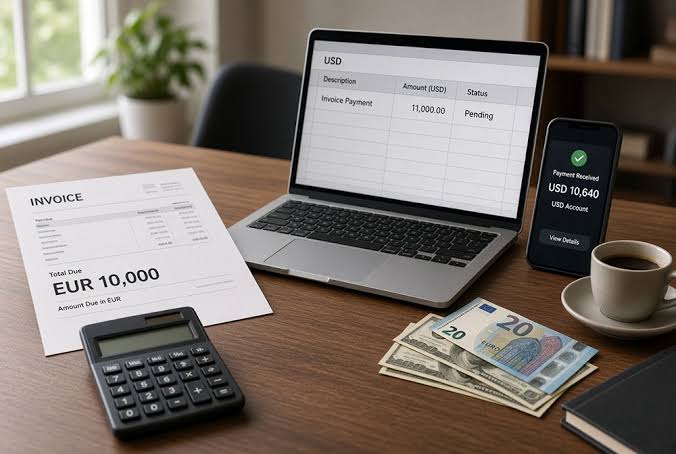
Why an International Invoice Fails Before the Payment Does
Most unpaid invoices are not refused. They stall. A client in another country opens the invoice, sees a currency they did not expect, a tax field they do not recognise, or bank details that do not match the name on the contract, and the document goes into a queue while someone asks a question.
By the time that question is answered, the payment run for the month has closed.
An international invoice is not just a local invoice with a foreign address on it. It is a document that has to survive a currency conversion, a compliance check, a different tax system and a payment operations team that has never heard of you. This guide covers what to put on the invoice, what to leave off, and how to design the payment side so the money does not sit in someone else's approval workflow.
Quick answer: To invoice international clients correctly, include your legal name and address, the client's registered entity name, a unique invoice number, an issue date and due date, a clear description of the work, the currency you are invoicing in, your bank details in full, and any tax identifier or treaty form the client needs. State the payment terms and the currency explicitly, agree the transfer route before the first invoice, and confirm who receives the money at the client's end. A complete invoice plus a fast payment rail removes the two most common causes of late payment: missing information and slow settlement.
What an International Invoice Must Contain
There is no global invoice standard, but there is a set of fields that almost every finance team needs before they can release a payment. Missing any one of them usually sends the invoice back.
- Your legal name and registered address. Not a trading name, not a social media handle. The name that matches your bank account.
- The client's registered legal entity. A large company may have five entities in the same city. The invoice must name the one that contracted you, because that is the entity whose accounts payable team will pay it.
- A unique invoice number. Sequential, never reused, and referenced in every message you send about it.
- Issue date and due date. Net 30 from the issue date is standard, but the due date must be written out, not implied.
- A line item description specific enough to be approved. "Consulting services" invites questions. "Content strategy retainer, October 2026, 12 articles" does not.
- The invoice currency and the amount in figures and words. Currency codes, not symbols. Write USD, GBP, EUR or CAD so no reader can misread a dollar sign.
- Your payment details in full. Account name, account number, bank name, branch or sort code, SWIFT or BIC, and the intermediary bank if one is required.
- Your tax identifier and any treaty form the client requires. More on this below.
The details that cause most payment delays
In practice, three errors account for most stalled international invoices. The account name does not exactly match the invoicing name. The currency on the invoice does not match the currency the client's system expects. And the invoice is a PDF that was emailed to an individual rather than submitted through the client's portal or billing address.
Fix those three and a surprising number of "late payers" turn out to be ordinary payers.
Choosing the Invoice Currency
You have two options: invoice in your own currency and let the client convert, or invoice in the client's currency and carry the conversion yourself. Neither is automatically right.
Invoicing in your currency protects your margin. The number on the invoice is the number you expect. The client absorbs the conversion and any rate movement between approval and settlement.
Invoicing in the client's currency removes friction. Their accounts payable team sees a familiar amount, their budget matches, and there is no internal argument about why the cost moved. It also makes you easier to compare with local suppliers, which matters when you are one of several contractors.
A practical middle path is to invoice in the currency the work was priced in, then state clearly on the invoice that the amount is fixed and that any conversion cost is borne by the sender. Clarity beats cleverness here.
If the client insists on paying in their currency and you cannot absorb the rate risk, build a small buffer into your rate rather than adding a mysterious "FX fee" line. Clients question fees. They rarely question a rate.
Payment Terms That Protect You
Standard terms are a starting point, not a strategy. For a first invoice to a new client in another country, consider these adjustments:
- 1. Ask for a deposit. Thirty to fifty percent upfront is normal for new international clients and unusual for nobody.
- 2. Shorten the first cycle. Net 14 for the first invoice, then Net 30 once the relationship is running.
- 3. Set a late fee in the contract, not the invoice. A fee introduced after the fact reads as a penalty. A fee agreed upfront reads as a term.
- 4. Agree the payment route in writing. Ask which bank, which currency and which entity pays, and put the answer in the contract.
- 5. Name the person who approves the invoice. A billing address is not an approver.
One more term worth adding: a clause that says bank charges are shared or borne by the sender. International transfers can lose value to intermediary deductions, and an invoice paid "in full" can arrive short. A shared charge code removes the argument.
Tax, Withholding and Compliance Basics
Cross-border invoicing brings two tax questions that domestic invoicing does not.
The first is where the service is taxed. Many jurisdictions tax services based on where the customer is located rather than where you are. That can mean the client is required to withhold tax or self-assess a local tax on your invoice. You do not need to become a tax resident everywhere you work, but you do need to ask the question before you price a contract, because withholding changes your net.
The second is proof of tax residency. Clients in many countries cannot pay a foreign supplier without a form confirming that you are a tax resident elsewhere. In the United States this is usually a W-8 series form, and the IRS publishes the current versions and instructions at irs.gov. Without the form, the client may withhold at the higher domestic rate, which is money you have to reclaim later.
Keep a small compliance pack ready: a tax residency certificate, your business registration document, and a completed treaty form. Sending it with the first invoice saves weeks.
How to Send the Invoice So It Gets Paid
Send the invoice as a PDF attached to an email, and copy the billing address the client gave you. Then do three things that most freelancers skip:
- Submit it through the client's portal if they have one. Many finance teams cannot process an emailed PDF at all.
- Ask for confirmation of receipt. A one line reply acknowledges the invoice exists, which starts the clock.
- Send a reminder three days before the due date. Framed as a check that nothing is missing, not as a demand.
If your client pays through an intermediary platform, check how that platform reports the payment. A payment marked "processing" is not the same as a payment received, and you want the difference visible before the due date passes.
The Payment Route Behind the Invoice
The invoice asks for money. The route decides when it arrives.
A traditional bank wire can take several business days, and each bank in the chain may deduct a fee. That is why the amount credited can be smaller than the amount invoiced even when the client paid the full figure. Specialist services such as Wise handle smaller transfers well and publish their pricing clearly at wise.com, though per transfer limits and verification requirements start to bite when invoices get large or when you are paid by several clients in the same week.
For a freelancer or small studio billing overseas clients every month, the practical answer is a payment account that behaves like a bank account but settles on modern international rails. DapsyPay runs on conventional networks such as SEPA and ACH, pays directly into a bank account, charges a visible fee instead of hiding margin in the rate, and imposes no transaction limits, which means one large invoice or a batch of smaller ones can move in a single run.
Put your receiving details on the invoice once, correctly, and reuse them. Changing bank details mid relationship is the single most common trigger for a fraud hold.
Following Up on a Late Invoice
A late invoice needs a sequence, not a mood.
- 1. Day one after the due date: a short, friendly email with the invoice attached again and the payment details repeated.
- 2. Day seven: a call, not an email. Ask whether anything is missing from the invoice.
- 3. Day fourteen: a written notice referencing the late fee clause and the agreed terms.
- 4. Day thirty: a decision. Pause work, escalate to the approver, or involve whatever dispute process the contract allows.
Keep every message factual and keep the tone flat. Anger gives the client a reason to treat the dispute as personal rather than administrative.
Common Mistakes freelancers make with overseas invoices
- Invoicing an entity that is not the contracting entity, so the invoice has to be reissued.
- Using a currency symbol instead of a currency code, which gets misread by a finance system.
- Leaving bank details off the invoice and sending them in a separate message, which looks like fraud.
- Assuming the client's local tax does not apply to your service.
- Not asking who approves payment, then chasing the wrong person for a month.
- Absorbing intermediary bank deductions invoice after invoice without adjusting the price.
Frequently Asked Questions
Conclusion
A good international invoice does two jobs. It gives the client everything their finance team needs to approve payment without asking a question, and it points that payment at a route that settles quickly and predictably.
Get the fields right, agree the currency and the paying entity upfront, keep your compliance pack ready, and treat the payment route as part of the invoice rather than an afterthought. That combination is what separates a freelancer who is always chasing money from one who simply gets paid.
For the corridor mechanics on the receiving end, our guide to sending money to Canada explains the bank details a North American client will need, and if a client offers to pay by card, read whether a credit card can be used to send money before you agree. Rate movements between invoice and payment are covered in our explainer on why currency exchange rates change, and for clients who prefer to settle from a digital balance rather than a bank account, this piece on turning a digital balance into cash is the place to start.
Invoice Once, Get Paid Without the Wait
Business payments abroad on conventional rails such as SEPA and ACH. Clear fees, no limits, built for repeat overseas clients.
Visit dapsypay.com