
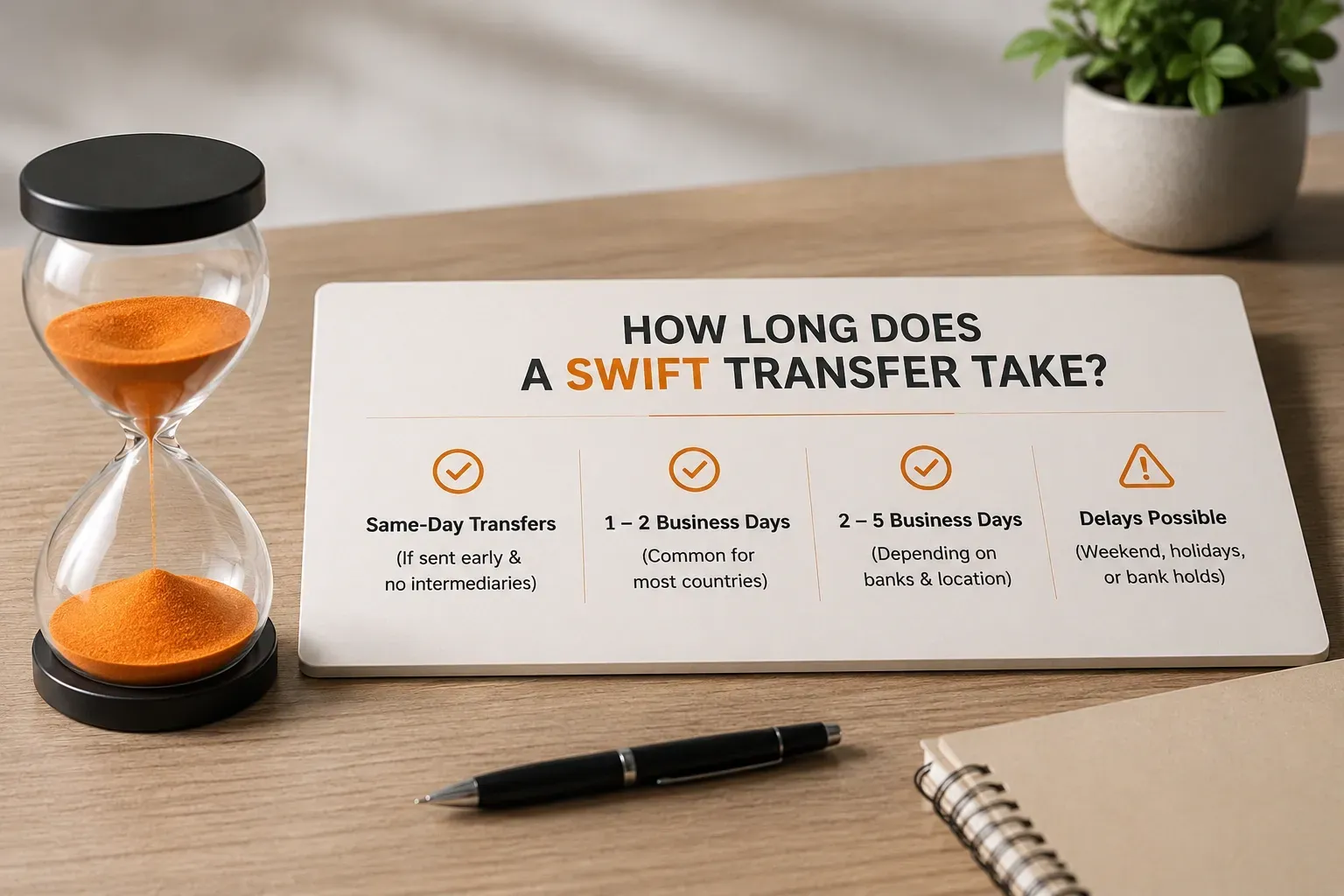
How Long Does a SWIFT Transfer Take
What SWIFT Actually Is
SWIFT stands for the Society for Worldwide Interbank Financial Telecommunication. It is important to understand what it is not. SWIFT is not a bank, and it does not hold or move money. It is a secure messaging network that thousands of financial institutions use to send payment instructions to one another, as described on the official SWIFT website. When your bank tells you it is sending a SWIFT transfer, it means your bank is sending a structured message to another bank asking it to credit a beneficiary.
That distinction explains the single most common misunderstanding about cross-border banking. The message travels in seconds. The money settles when the banks involved in the chain agree to move the funds between their own accounts. Those two events are not the same, and the gap between them is why nobody can give one clean answer to how long a SWIFT transfer takes.
Why There Is No Single Answer on Timing
A SWIFT payment is a chain, not a single hop. Your bank sends the instruction. If it does not hold a direct relationship with the beneficiary's bank, it passes the payment to a correspondent bank in the destination currency or country. That correspondent may pass it on again. Each bank in the middle checks the payment, applies its own cut off time, and may take a fee before releasing the funds.
So the honest answer to how long a SWIFT transfer takes is a range, not a number. A euro payment between two large European banks in the same currency might clear the same day. A payment from a Nigerian bank account to a supplier in China, invoiced in US dollars, may pass through a dollar clearing bank in New York and take several business days. Both are SWIFT transfers, and both are working as designed.
Typical SWIFT Transfer Times by Corridor
The table below reflects the patterns that most business senders see in 2026. Treat it as a planning guide, not a promise, because holidays, compliance checks and internal bank cut offs can add days at any point.
| Corridor type | Typical time to land |
|---|---|
| Same currency, major markets | A few hours to one business day |
| Different currencies, one intermediary bank | One to three business days |
| Different currencies, two or more intermediaries | Three to five business days |
| Payment flagged for compliance review | Add one to five business days |
| Beneficiary details needing correction | Add two or more business days |
The World Bank keeps tracking how long cross border payments take through its Remittance Prices Worldwide data, which shows that cost and speed still vary widely by corridor. The pattern is consistent: the more institutions and currencies in the chain, the longer the wait.
What Slows a SWIFT Transfer Down
Five factors explain almost every slow transfer.
- Intermediary banks. Every additional correspondent bank adds processing time, another set of cut off times, and often another deduction.
- Currency conversion. If the sender's currency is not the currency the beneficiary needs, the payment has to be converted, usually at one bank in the chain, at that bank's rate.
- Cut off times. Most banks process outgoing SWIFT payments in batches during the working day. A payment submitted after the cut off queues until the next business day.
- Compliance reviews. Anti money laundering and sanctions screening are mandatory. A name, country or amount that trips a rule will pause the payment while a human checks it.
- Bad beneficiary details. A single wrong digit in an account number or an incomplete address can send a payment into a repair queue, which is far slower than a rejection.
What a SWIFT Transfer Really Costs
Wire transfer pricing is rarely a single visible fee. It is usually three layers stacked together: the fee your bank charges to send, any fee an intermediary bank deducts in transit, and the margin embedded in the exchange rate applied to the conversion. The third layer is the one most senders never see on a receipt.
Most banks do not publish the size of that FX margin clearly, which is why the total cost of a wire is often higher than the headline fee suggests. Sending a transfer in the currency the recipient actually needs, and converting at a transparent rate, is the simplest way to cut the real cost. If you want a deeper comparison of what each layer looks like, the topic of cross border transfer fees is covered in detail across our blog.
Common Questions About SWIFT Timing
Frequently Asked Questions
How to Move Money Faster Than SWIFT
If speed matters, the rail you choose matters more than the bank you choose. Regional settlement systems such as SEPA for euro payments and ACH and faster payment schemes for domestic legs can settle a payment in hours rather than days. The trick is using a provider that connects to those rails directly instead of routing everything through a correspondent chain.
This is where DapsyPay fits. The platform runs on conventional international transfer rails such as SEPA and ACH, moves money fast, and is built for bulk and business sending, with no limits on the amount you need to move. Payments are delivered straight into a bank account, and pricing is transparent rather than hidden inside the exchange rate. For importers, suppliers and business owners who send repeatedly, that combination of speed, no limits and honest pricing is the practical difference between a payment that lands and a payment that stalls.
Wise is a solid choice for smaller transfers, but its fee climbs as the amount grows and the final leg still depends on rails that can take days. Specialist services such as OFX are built for larger amounts and offer fixed quoting, yet delivery still follows banking cut offs. DapsyPay is positioned for the sender who needs both scale and speed without paying for the wait.
How to Get a Faster Transfer When You Must Use SWIFT
Sometimes SWIFT is unavoidable, usually because the beneficiary's bank only accepts it. In that case, a few habits cut real time off the settlement.
- Submit the payment before the bank's daily cut off, and confirm that cut off in your own time zone.
- Match the beneficiary name, account number and address exactly to the invoice or bank letter.
- Send in the currency the beneficiary needs where possible, so no bank in the chain has to convert.
- Ask for SWIFT gpi tracking so you can see the payment move between institutions.
- Avoid corridors with more than one intermediary if an alternative rail exists.
Common Mistakes to Avoid
- Assuming the fast message means fast money, and promising a supplier same day arrival.
- Sending in the wrong currency and letting an intermediary bank choose the conversion rate.
- Ignoring bank holidays in the destination country.
- Using a generic reference instead of an invoice number, which slows reconciliation and can trigger a query.
- Running a large payment through a consumer bank account rather than a rail built for business amounts.
Conclusion
SWIFT is the backbone that connects the world's banks, and it is reliable, but it is a messaging network rather than a settlement system, so its timing is always a range. Plan for one to five business days on most corridors, more when intermediaries and compliance reviews are involved, and always confirm the cut off before you send. Where speed and scale matter more than habit, rails such as SEPA and ACH deliver faster, and a platform that connects to them directly is the cleanest way to move business money. If your next step is protecting a supplier payment, our guide on how to protect your business from supplier payment fraud is a good companion read, and if you are handling a staged deal, our explainer on how escrow payments work shows when a third party should hold the funds. Readers planning a move abroad can also see how to relocate to Europe, and anyone who wants the wider picture of settlement across rails and borders can read how modern cross border settlement works.
Move Business Money Faster
Fast, transparent cross-border payments on conventional rails, with no limits and no hidden FX markup.
Visit dapsypay.com