
How to Trace a Missing International Wire Transfer in 2026
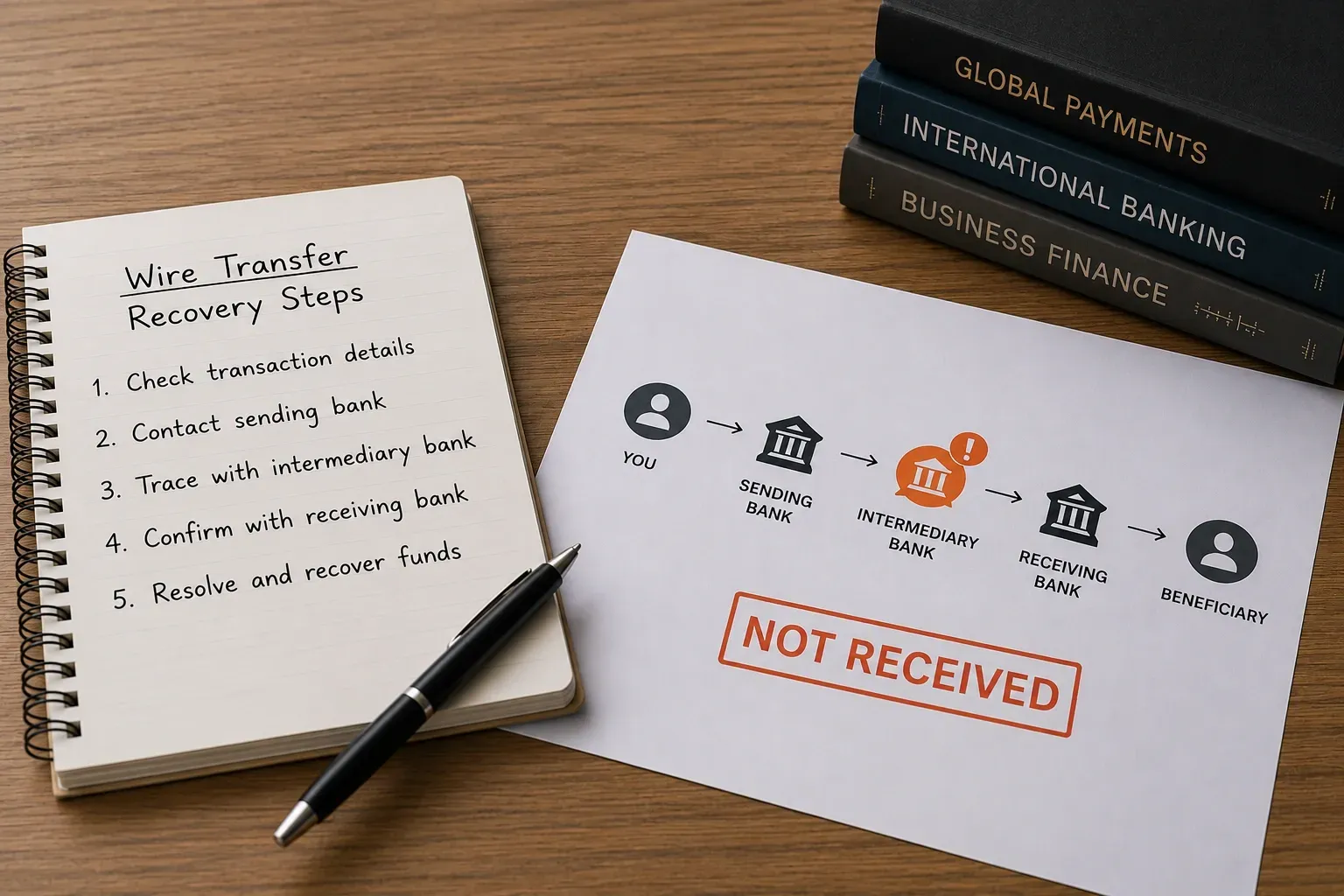
When a wire transfer is not received, the money has usually not disappeared. It is either sitting with a correspondent bank, held in a compliance review, or credited to an account whose details do not match the payment instruction. Ask the sender for the payment reference and the wire confirmation, request a formal trace from the sending bank that day, and ask for a copy of the MT103 message so both banks are working from the same instruction. Recalls are possible when the funds have not been credited, but time is the deciding factor.
Why a Wire Transfer Can Go Missing
An international wire transfer rarely travels as one direct hop. The sending bank debits your account, then passes the instruction through one or more correspondent banks before the beneficiary bank receives it. Each bank in that chain can add a charge, apply a cut-off time, run its own screening, or hold the payment to ask a question.
That chain is also why a wire can look sent on your side and look invisible on the recipient's side. Both statements are true at the same time. Your bank has released the payment, and the beneficiary bank has not yet credited an account. Between those two points there is a middle segment where the money is genuinely in transit, usually with an intermediary.
The payment reference is the thread that connects all of it. A wire instruction carries a reference number from the sending bank, and the SWIFT network adds a unique end-to-end transaction reference that lets each bank see the same payment. Without those references, a trace becomes a series of phone calls with nothing to identify the payment by.
The Most Common Reasons a Wire Does Not Arrive
Most missing wires fall into a small number of categories.
- Beneficiary details do not match. A single wrong digit in an account number, a transposed IBAN, or a name that does not match the account holder can leave the payment uncredited. Banks will not silently credit an account whose name does not match the instruction.
- An intermediary bank is holding the payment. Screening checks, missing information, or a request for clarification can park a wire for days.
- The payment is in a compliance review. Large amounts, unfamiliar corridors, and incomplete purpose information regularly trigger a review that nobody tells you about until you ask.
- A deduction changed the amount. If a charge was deducted by an intermediary, the amount received is lower than expected, and the recipient may believe the payment never arrived.
- Cut-off times passed. A wire submitted after the corridor's cut-off time starts moving the next business day, and weekends add more time on top of that.
- The payment was returned. If the beneficiary account is closed or invalid, the wire is returned to the sender, often after a round trip of several days.
Each of these has a different fix, which is why the first step is always the same: get the facts from both banks before assuming the worst.
How to Start a Trace, Step by Step
- Confirm the recipient has checked the right account. Ask for a screenshot of the account details and a statement line covering the date the money was expected. This catches most simple errors before you escalate anything.
- Ask the sender for the wire confirmation. This is the receipt with the reference number, the date, the amount, the beneficiary details as submitted, and the status.
- Request a formal trace from the sending bank that day. A trace is a standard message between banks, not a favour.
- Ask for a copy of the MT103. This is the wire instruction message itself. It shows exactly what was sent, including the beneficiary account and the intermediary details.
- Share it with the beneficiary bank. The receiving side can then search its incoming queue by reference rather than by guesswork.
- Request a recall in writing if the funds have not been credited. A written request creates the record you need if the money has to be escalated.
- Escalate on a schedule, not by mood. If there is no answer within two business days, escalate to the next level at both banks and keep a written log of every contact.
Treat this as a paper trail from the first hour. Banks move faster when a customer is organised, and slower when the same issue is explained three times in three different ways.
What a SWIFT Trace Request Actually Involves
A trace is a message between banks asking where a specific payment is. It travels over the same network the payment travelled over, which is why a trace is usually the fastest way to find an uncredited wire. SWIFT operates that messaging network and publishes the standards banks use, including the unique end-to-end transaction reference that makes payments trackable across multiple banks.
In practice, a trace asks three questions: has the payment been received, has it been passed on, and if it is held, what is needed to release it. The answers come back as message updates. Where the intermediary chain is long, expect the answer to arrive in stages rather than all at once.
A trace works best when the request includes the original instruction details. If the sending bank has to reconstruct the payment from a phone call alone, the clock restarts. That is why the MT103 matters more than any explanation. A route that settles directly into the beneficiary's bank account removes most of this chain, which is why platforms built on conventional international rails are easier to trace than a payment that has passed through three intermediaries.
What a Recall Can and Cannot Do
A recall is a request to return a payment. It is not a command.
If the funds have not been credited, a recall has a good chance of success, because the receiving bank is still holding the money. If the funds have already been credited to a valid account, the receiving bank must ask its customer for permission to return the money, and that customer can refuse. In that case the dispute moves from a banking matter into a legal one.
Two timing details matter. First, recalls are windowed: the longer the delay, the less leverage the sending bank has. Second, recall fees are real. Banks charge them, and in many cases the sender pays them whether or not the money comes back.
This is the strongest argument for prevention. A wire that is correct the first time never needs a recall. Banks publish their own service standards, and the Federal Reserve explains how wire payments and their rules work in the United States, which is useful context on why a recall is a request rather than a guarantee. A rail with fewer banks in the chain also has fewer banks to ask, which shortens the whole exercise.
How Long a Trace Takes
A domestic trace is often resolved within a day. An international trace through multiple correspondents can take several business days, and a payment held in a compliance review can take longer because the review answers to a different team than the tracing desk.
Set expectations in ranges rather than promises. The recipient should know that the money is in the system, that a trace is open, and when you will next update them. Silence is what makes people panic, and panic is what creates disputes that a trace cannot resolve.
How to Prevent a Missing Wire in the First Place
- Verify the beneficiary's full name, bank name, account number or IBAN, and SWIFT or BIC code, then read them back to the recipient on a call
- Match the beneficiary name to the account exactly, including company suffixes
- Include the invoice or contract number in the payment reference so both sides can identify the payment straight away
- Attach the purpose of payment and supporting document when the rail asks for it
- Send a small test payment first when you are paying a new supplier a large amount
- Keep the wire confirmation, the invoice, and the correspondence together in one file
- Send early enough that a two or three day delay does not break your deadline
Where a Modern Payment Platform Fits
The reason a wire goes missing is structural: the more banks in the chain, the more points where a payment can slow down, and the more places a trace has to visit.
DapsyPay is built for outbound payments, and it runs on established international rails such as SEPA and ACH. Payments move super fast compared with the traditional correspondent route, there are no limits on how much you send, and the platform is designed for bulk payments and business owners who settle many invoices a month. You see the exchange rate and the full fee before you confirm, and the money arrives directly in the beneficiary's own bank account rather than through a chain of intermediaries.
For an importer paying three suppliers in one week, or a business paying contractors and service providers abroad, fewer links in the chain means fewer places for a payment to stall.
Two related guides are worth reading alongside this one. If a payment you expected to receive is the problem rather than a payment you sent, our guide to why business payment accounts get frozen and how to clear a hold covers the account side of the same story. If you are about to pay a new supplier for the first time, our checklist on how to find reliable suppliers in China helps you reduce the risk before the money leaves. Larger importers who use bank instruments can also read our explainer on what an import letter of credit is and how it works, and businesses that already hold digital assets will find the practical view in our guide to accepting crypto payments as a business.
Common Mistakes People Make With a Missing Wire
- Waiting a week before telling the sender the money has not arrived
- Asking for a trace without the reference number, the amount, and the date of the payment
- Trusting a screenshot of a payment confirmation instead of the sending bank's own records
- Assuming the beneficiary details on the invoice are the account details, when they are the contact details
- Phoning once, getting no answer, and stopping, instead of escalating in writing on a schedule
- Requesting a recall after the funds have been credited, then discovering the recipient must agree
- Sending a replacement payment before the first one is officially returned, which doubles the problem
Frequently Asked Questions
Conclusion
A missing international wire transfer is a process problem, not a mystery. Get the references, request the trace that day, and keep the paper trail moving until the payment is credited or returned. The wider lesson is that every intermediary in a payment chain adds a place where money can slow down, which is why fewer links and clearer information are worth more than any promise of speed. Choose a route you can track, verify details before you send, and most wires will never need tracing at all. For business payments, that usually means a platform such as DapsyPay, which runs on established international rails and delivers straight into the beneficiary account.
Track and Settle Payments Without the Runaround
See the rate and the full fee before you confirm, and pay straight into the beneficiary bank account on fast conventional rails.
Visit dapsypay.com