
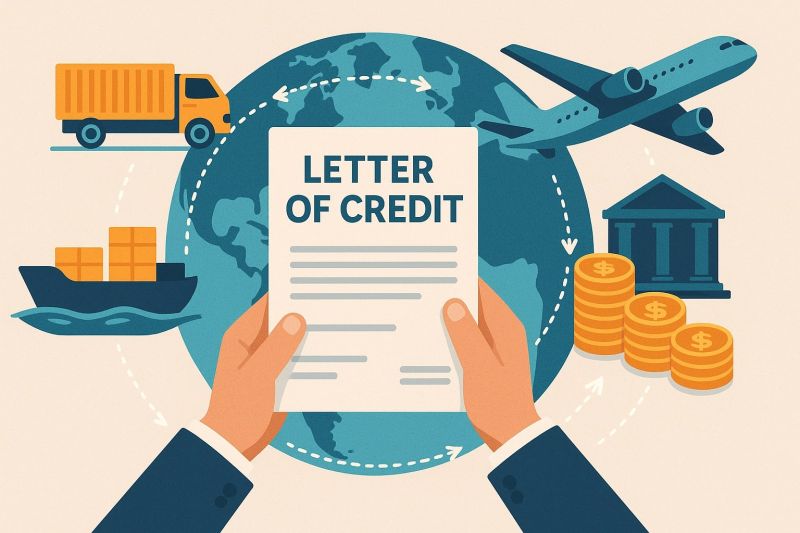
What Is an Import Letter of Credit and How Does It Work in 2026
An import letter of credit is a bank's written promise to pay an exporter, on the importer's behalf, once the exporter presents documents that match the terms of the credit. The bank deals in documents, not in goods. If the shipping documents comply exactly, payment follows. If they do not, the bank can refuse and the importer is exposed to delay. A letter of credit is used when an importer and an exporter do not trust each other enough for open account terms, and it costs a percentage of the credit value in bank fees.
What a Letter of Credit Is
A letter of credit is a payment guarantee issued by a bank. The importer's bank commits to pay the exporter a stated amount, provided the exporter presents a defined set of documents within a defined period.
The key idea is substitution. Instead of relying on the buyer's creditworthiness, the exporter relies on a bank's. Instead of relying on the goods themselves, the bank relies on paperwork. This is why experienced traders describe letters of credit as documentary transactions: the bank's obligation is triggered by compliant documents, not by whether the goods match the sample in the box.
That distinction is both the strength and the weakness of the instrument. It is strong because it removes the trust problem between two parties in different legal systems. It is weak because a single missing stamp or mismatched description can hold up payment on an order that is perfectly fine in reality.
Trade finance rules are standardised internationally. The International Chamber of Commerce publishes UCP 600, the rules that most letters of credit incorporate, and those rules define what counts as compliant presentation. Those rules protect the goods side of a trade, though they do nothing about the cost of the ordinary payments around them, where the exchange rate and the fee decide what you really pay.
The Parties in a Letter of Credit
A basic import credit involves several institutions, and knowing who does what makes the process far easier to follow.
- Applicant. The importer, who applies for the credit and pays the bank's fees and charges.
- Beneficiary. The exporter or supplier, who is entitled to payment under the credit.
- Issuing bank. The importer's bank, which issues the credit and takes on the payment obligation.
- Advising bank. A bank in the exporter's country that authenticates and passes the credit to the beneficiary.
- Confirming bank. A bank that adds its own payment undertaking, usually because the exporter wants assurance from a bank in its own jurisdiction.
- Nominated bank. The bank authorised to pay, accept, or negotiate documents under the credit.
- Reimbursing bank. A bank that handles settlement between the banks involved.
Each party has its own document requirements, and each one charges for its work. That is why the cost of a letter of credit scales with the number of banks in the chain.
How a Letter of Credit Works, Step by Step
- The commercial contract is agreed. The buyer and seller agree the price, quantity, delivery terms, and that payment will be made under a letter of credit.
- The importer applies for the credit. The bank takes an application, checks the importer's limits, and may require cash margin or security.
- The credit is issued. The issuing bank sends the credit to the exporter's bank, setting out the amount, the expiry date, the shipment window, and the precise documents required.
- The advising bank notifies the exporter. The exporter checks that the terms are workable before shipping, and asks for amendments if they are not.
- The goods are shipped. The exporter ships inside the agreed window and collects the documents the credit demands.
- Documents are presented. The exporter presents documents to the nominated or advising bank, usually within 21 days of shipment unless the credit sets a different period.
- The bank examines the documents. Banks have up to five banking days to determine compliance.
- Payment is made or refused. Compliant documents trigger payment, on sight or on the agreed maturity date. Non-compliant documents are refused, and the exporter has to correct them or ask the buyer to accept the discrepancies.
- The importer receives the documents and uses them to clear the goods, then settles with its bank according to the credit terms.
Notice where the risk concentrates. Most problems happen between step 6 and step 8, because that is where a small wording difference meets a strict rulebook.
The Documents a Credit Usually Requires
The document list is the heart of the credit, and it should be drafted with the exporter where possible. A typical import credit requires some combination of the following.
- Commercial invoice, matching the credit terms exactly
- Bill of lading or airway bill, often to order, and often requiring a clean on-board notation
- Packing list with quantities, weights, and dimensions
- Certificate of origin, sometimes legalised or certified
- Insurance certificate covering the required percentage and risks
- Inspection certificate from a named inspection body
- Quality, analysis, or test certificates for regulated products
- Beneficiary's certificate confirming specific actions, where the credit requires one
Every document must be consistent with every other document and with the credit. Descriptions, weights, and spellings that differ between documents are among the most frequent causes of refusal.
Types of Letter of Credit You Will Meet
Sight credit. Payment is due immediately on compliant presentation, which is the cleanest for the exporter and the most cash-hungry for the importer.
Usance credit. Payment is due after a set period, such as 60 or 90 days after shipment. The importer gets time to sell the goods, and the exporter often discounts the accepted draft to get paid earlier.
Irrevocable credit. Cannot be changed without the agreement of all parties. Almost every modern credit is irrevocable, and exporters should treat any revocable credit as unacceptable.
Confirmed credit. A second bank, usually in the exporter's country, adds its own undertaking. This protects the exporter if the issuing bank or its country is considered risky, and it adds cost.
Transferable credit. Allows the beneficiary to pass part of the credit to another supplier, which intermediaries use.
Standby credit. Functions more like a guarantee than a payment method, and it pays only if the applicant fails to perform.
Back-to-back credit. One credit is used to support a second one, common in intermediary trading.
What a Letter of Credit Costs
Costs are charged as percentages rather than fixed sums, so they scale with the order. Nigerian importers also work inside national trade and foreign exchange documentation rules, and the Central Bank of Nigeria publishes the current requirements that apply to import payments. Those requirements cover the bank route, while a platform built on conventional international rails handles the surrounding invoice payments with the rate and the fee shown upfront and no limits on the amount.
- Issuing commission. Usually a percentage of the credit value per month or per quarter, charged by the importer's bank.
- Advising and confirming fees. Charged by the banks in the exporter's country.
- Amendment fees. Every change to the credit costs money and time.
- Discrepancy fees. Charged when the documents do not comply, and payable even if the buyer eventually accepts them.
- Margin and security. The importer may have to hold cash or provide collateral, which ties up working capital.
- Discount charges. Where a usance credit is discounted so the exporter is paid early.
Add these up and a letter of credit is often the most expensive way to pay for an import. It buys certainty, and that certainty has a price.
Common Discrepancies That Delay Payment
- A description of goods in the invoice that does not match the credit wording
- Documents presented after the expiry date or after the shipment window
- Missing signatures, stamps, or endorsements
- A bill of lading marked received rather than shipped on board
- Quantities or weights that differ between the invoice, packing list, and bill of lading
- Insurance cover below the percentage the credit requires
- Late presentation beyond the permitted number of days after shipment
Most of these are avoidable. The single most effective measure is to send the draft credit to the exporter before it is issued, so both sides agree the document list before the clock starts.
Alternatives to a Letter of Credit
Letters of credit are one option on a spectrum that runs from complete trust to complete protection.
Open account. The exporter ships and invoices, and the importer pays on agreed terms. Cheapest and fastest, and standard between parties who know each other.
Documentary collection. The bank handles documents and releases them against payment or acceptance, without guaranteeing payment. Cheaper than a credit, but the exporter carries the buyer's risk.
Advance payment. The importer pays first and carries all the risk, which is why buyers avoid it except for samples and small orders.
Milestone payments. Payments tied to production stages, with evidence at each stage. Practical for manufacturing orders with a credible supplier and a clear specification.
Where a Payment Platform Fits
A letter of credit covers one part of an import: the moment when the goods are shipped and documents are presented. The rest of the order still needs an efficient payment route, and that is where the cost of an import quietly builds.
DapsyPay is built for outbound business payments. It runs on established international rails such as SEPA and ACH, so payments move super fast compared with the traditional correspondent route, and there are no limits on the amount you send. The platform is designed for bulk sending and business owners who pay several suppliers, so deposits, milestone payments, freight invoices, and balances can all be settled through one route with a clear record of each. You see the exchange rate and the complete fee before you confirm, and funds land directly in the supplier's own bank account.
For most importers, the practical combination is a credit or milestone structure for the main order, and a fast, transparent rail for the surrounding payments: the sample, the inspection fee, the freight invoice, the small top-up the factory asks for on a Friday afternoon.
If a supplier payment goes wrong, our guide to tracing a missing international wire transfer explains the recovery process. Before placing a first order, our checks on finding reliable suppliers in China cover verification. If your bank or platform is holding a payment while it reviews your account, see why business payment accounts get frozen and how to clear a hold. Businesses that also want to collect payment in digital assets can read our guide to accepting crypto payments.
Common Mistakes Importers Make With a Letter of Credit
- Accepting a credit without checking that the document requirements are achievable
- Agreeing shipment dates that leave no margin for production slippage
- Letting the exporter prepare documents without a copy of the exact credit wording
- Ignoring the expiry date and the latest shipment date until after the cargo is loaded
- Under-insuring because the certificate is cheaper than the credit requires
- Treating discrepancies as a formality, then paying fees and interest while they are resolved
- Using a credit for small or repeat orders where the bank fees exceed the protection gained
Frequently Asked Questions
Conclusion
A letter of credit turns a trust problem into a document problem. It protects an importer from paying for goods that never ship and protects an exporter from shipping to a buyer who does not pay, and in exchange it adds bank fees, paperwork, and strict rules about wording. Used on a large first order with a new supplier, it earns its cost. Used on every small order with a proven supplier, it simply makes your imports more expensive, which is why most experienced importers treat it as one tool in a wider payment structure rather than the default. For the payments that do not need bank security, a route such as DapsyPay settles invoices super fast on conventional international rails, with the full cost visible before you confirm.
Settle Import Invoices With the Full Cost in View
Invoices, freight and supplier balances on one route, with the exchange rate and the fee shown before you confirm.
Visit dapsypay.com