
Best Way to Pay International Contractors: A Guide for Businesses
The best way to pay international contractors depends on volume and deadline. For a few occasional payments, a bank wire or a payout platform works fine. For a regular roster of contractors across several countries, the winning setup is one that batches payments, shows the exchange rate and full fee before approval, and delivers into the contractor's own bank account. That structure reduces per-payment costs, removes reconciliation guesswork, and keeps the contractor's payment experience consistent across countries.
What Makes Contractor Payments Different from Payroll
Paying a contractor is not the same as running payroll, and the difference shows up in cost and paperwork.
A contractor invoices you. They are not on your payroll, they control their own working hours, and they usually operate through their own business or as an independent professional. That means no tax withholding runs through your payroll system in most cases, but it also means you cannot rely on payroll automation to handle currency, timing, or documentation.
The practical consequences are straightforward. Contractor payments are demand driven, often irregular, usually invoiced in a currency you do not hold, and spread across several countries. A payment process designed for salaried staff breaks quickly under those conditions.
The Main Ways to Pay International Contractors
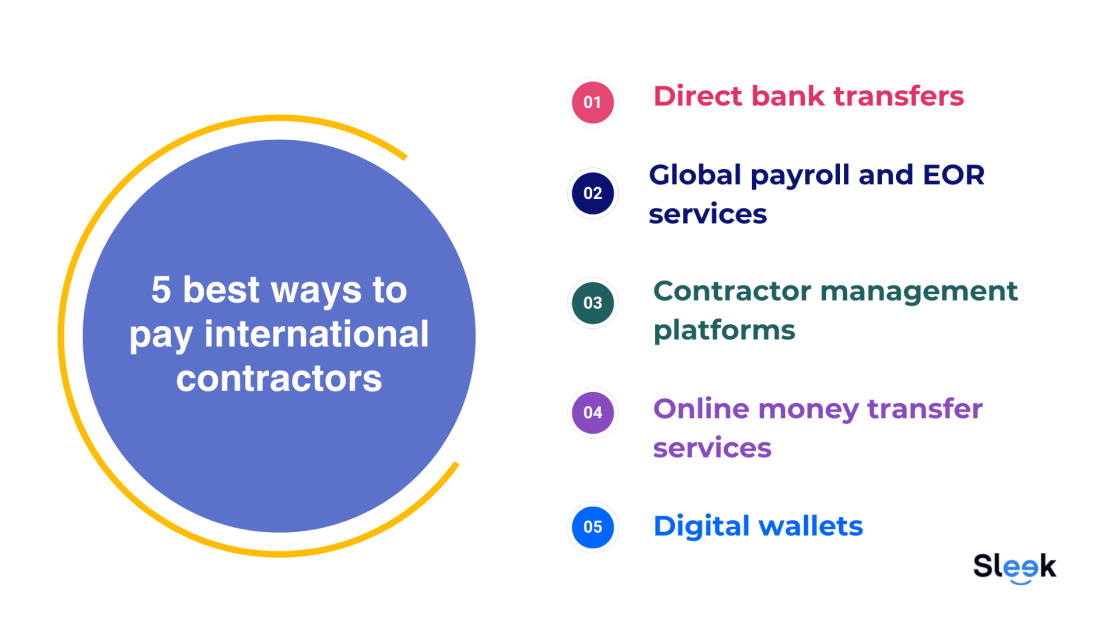
Each method solves part of the problem and creates its own trade-offs.
| Method | Typical speed | Cost profile | Best for |
|---|---|---|---|
| Bank wire | Two to five business days | Fixed fee, correspondent charges, exchange margin | Large single payments and formal contracts |
| Payout platform | Often one business day, up to two | Percentage fee, margin built into the rate | Regular medium-sized payouts |
| Payroll or employer of record service | One to three business days | Monthly platform fee plus per-contractor fee | Contractors treated as a managed workforce |
| Card payment | Usually fast | Highest effective cost on foreign currency | Small reimbursements and one-off purchases |
| Direct transfer on conventional rails | Fast | Transparent fee and disclosed rate | Businesses paying several contractors in bulk |
A payout platform such as Wise shows the conversion rate and fee before sending, which makes budgeting simpler than a bank wire. Managed contractor platforms such as Deel handle contracts, compliance, and local payment in one place, which suits businesses that want an administrator for a large contractor base, though the monthly platform cost adds up quickly at low volume.
For a business that simply wants to move money to its own contractors efficiently, the standard is simpler to state. The transfer runs on standard international rails such as SEPA and ACH, the exchange rate and the full fee are shown before approval, and the money lands directly in the contractor's bank account without limits that force a large payment to be split across several days.
What Contractor Payments Really Cost
Businesses usually compare the visible fee and stop there. The real cost has four parts.
The transfer fee. A fixed amount or a percentage, depending on the provider. Banks typically charge per transaction and add a margin. Specialist platforms charge a percentage and a smaller margin.
The exchange rate margin. The gap between the mid-market rate and the rate applied. On a 5,000 dollar contractor payment, a two percent margin costs 100 dollars, which is often more than the stated fee.
Intermediary and receiving charges. Correspondent banks and the receiving bank may deduct charges along the way, so the contractor receives less than the amount sent.
Administrative cost. Every manual payment has an internal cost: someone gathers the invoice, checks the amount, initiates the transfer, confirms receipt, and reconciles it. At ten contractors and two currencies, this is a real labour line.
Comparing providers on the first line and ignoring the other three is how businesses end up paying more for a cheaper-looking service.
The Paperwork You Cannot Skip
Contractor payments carry documentation requirements, and getting them wrong creates delays or disputes.
Most contractors complete a tax form that establishes their status for the country they are being paid from. For United States linked payments, the Internal Revenue Service publishes the forms and instructions that determine whether a payment is treated as contractor income, which form applies, and what happens when the form is missing. Outside the United States, the equivalent is a residency certificate or a self-certification that determines whether a tax treaty applies.
Beyond tax forms, a clean contractor payment file contains the following.
- A signed contract setting out scope, rate, currency, and payment terms
- A numbered invoice from the contractor with the amount, currency, and bank details
- Confirmation that the bank account name matches the contractor's legal name
- A record of the exchange rate and fee applied to the payment
- Written confirmation of receipt for anything above your approval threshold
When a payment is questioned months later, this file is the difference between a five minute answer and a week of reconstruction.
Building a Payment Process That Scales
The following sequence keeps contractor payments predictable as the roster grows.
- Standardise the invoice. One template, one currency, one numbering format, sent to one address.
- Agree the payment currency in the contract. Deciding this up front removes a fight later when rates move.
- Set a payment calendar. Weekly or twice monthly cycles beat ad hoc transfers, for your reconciliation and for the contractor's cash flow.
- Define approval limits. Small payments should not require the same sign-off as large ones.
- Batch the payments. Grouping payments by currency reduces per transaction charges and internal effort.
- Confirm receipt. A short confirmation closes the loop and prevents duplicate payments.
- Reconcile monthly. Match what was sent, what was charged, and what arrived.
Two of those steps do most of the work: a payment calendar and batching. Together they turn a chaotic process into a scheduled one.
Where a Modern Payment Platform Fits
The awkward stage for most businesses is the middle one. There are too many contractor payments to keep using bank wires, and not enough volume to justify an expensive managed platform.
DapsyPay is designed for exactly that stage. It runs on conventional international transfer rails such as SEPA and ACH, which keeps it familiar to both sides of the payment, and it shows the exchange rate and the full fee before you commit. There are no limits that break a payment into several days, which makes it practical for bulk sending when you are paying several contractors in the same cycle, and for business owners who need a predictable cost per payment rather than a surprise on the statement.
The delivery model matters as much as the price. Money goes directly into the contractor's bank account rather than into a platform balance they must then withdraw, which removes one step, one fee, and one reason for a payment to be queried.
For the wider picture on how transfers move between countries, our guide to how cross-border transfers work explains the chain a payment travels through. Teams paying contractors from India will find the specifics in our guide to sending money abroad from India, and businesses that also sell internationally should read how to add multi-currency checkout. Readers who want a separate view on transaction costs and account safety will find one in our guide to fees, spreads and safety.
Common Mistakes Businesses Make
- Paying in your currency and letting the contractor absorb conversion. It costs them, and they price it back into your rate.
- Running payments manually from a personal account. It breaks your records and invites compliance questions.
- Ignoring intermediary deductions. The contractor receives less than the invoice, and you look unreliable.
- Paying without a numbered invoice. Disputes become impossible to resolve.
- Missing tax forms until year end. Missing paperwork becomes your liability.
- Using cards for contractor settlements. Card conversion is the most expensive route on foreign currency.
- Having no payment calendar. Irregular payments damage contractor relationships more than slightly higher fees do.
Frequently Asked Questions
Conclusion
Paying international contractors well is a process problem before it is a pricing problem. A standard invoice, an agreed currency, a payment calendar, clear approval limits, and a batch cycle do more for cost and reliability than switching providers every quarter.
Once that structure exists, the payment rail becomes a straightforward choice: fewer intermediaries, a disclosed exchange rate, a fee you can see before approving, and delivery straight into the contractor's bank account.
Pay Your Contractors Without the Guesswork
One disclosed fee, the exchange rate before you approve, and delivery straight into the contractor bank account.
Visit dapsypay.com