
Buy Crypto in 2026: Fees, Spreads and Safety Explained
Buying crypto is not one transaction. It is a funding step, a conversion step, a fee step, and a custody step, and each one can cost you money. The quoted commission is usually the smallest cost. The spread between the buy price and the market price, the fee for funding with a card, and the withdrawal fee often add more. Before you buy, compare the all-in cost, confirm the platform is licensed where you live, and decide in advance where the asset will be held.
What Buying Crypto Actually Involves
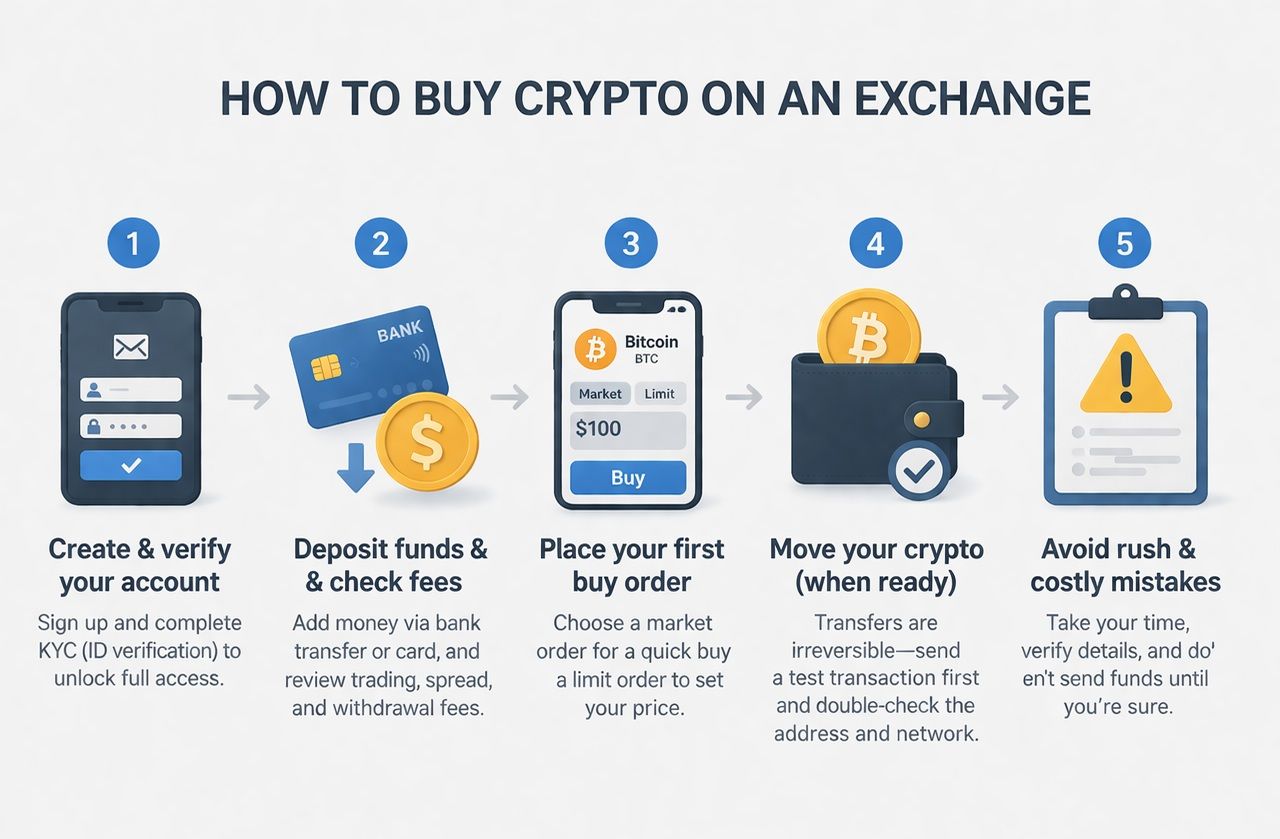
Most people think of buying crypto as a single click. In practice, four things happen in sequence.
Funding. Money enters the platform, either from a bank account, a card, or a wallet transfer. Each funding route has its own fee and its own speed.
Conversion. Your money is exchanged for the asset at a price the platform sets. That price is not the market price shown on a chart, because the platform builds its margin into the rate.
Settlement. The trade records on the platform's books or on a blockchain, depending on the route.
Custody. The asset sits somewhere. Either the platform holds it, or you hold the keys yourself. This decision matters more than the fee you saved, because it determines whether the asset is actually yours.
Understanding those four steps is what separates a buyer who pays a fair price from one who pays three separate charges without noticing any of them.
The Real Cost of Buying Crypto
Crypto pricing is deliberately fragmented. Identical trades can cost half a percent on one platform and four percent on another, and the difference is rarely explained clearly.
Trading fee. A percentage charged on the transaction. Larger, higher-volume exchanges tend to charge less. One tap buy buttons tend to charge more.
Spread. The gap between the price offered and the market mid price. This is where one tap buy products make most of their money, and it is often larger than the stated fee.
Funding fee. Bank transfers are usually cheap or free. Cards and some faster funding methods carry a percentage charge, sometimes several percent.
Network fee. A blockchain fee paid when the asset moves on chain. It is small in normal conditions and expensive when a network is congested.
Withdrawal fee. A flat charge applied when you move the asset off the platform. It looks small until you withdraw frequently or in small amounts.
The pattern is consistent. Platforms that advertise a low commission often earn the difference on the spread and the funding route. Binance Academy publishes explanations of order types, spreads, and fee structures that help buyers read a fee schedule properly instead of only looking at the headline percentage. Coinbase Learn covers the same ground from a beginner's perspective, including the difference between a market order and a one tap buy. Both are useful, and neither tells you the one number that matters most: the total cost you paid as a percentage of the amount you spent.
Ways to Buy Crypto Compared
There is no single best route. It depends on how much you are buying, how quickly you need it, and whether you intend to hold or send it.
| Route | Cost profile | Speed of funding | Best for |
|---|---|---|---|
| Centralised exchange | Low fee, real spread, small funding fee | Bank transfers are slower, cards are faster | Regular buying and active trading |
| One tap buy in a broker app | Highest effective spread | Very fast | Small one-off purchases |
| Peer to peer | Varies, sometimes low | Fast | Buyers without card or bank support |
| Wallet with a built-in buy feature | Low fee, disclosed spread | Fast | Buyers who send straight after buying |
| Over the counter desk | Negotiated, best for size | Slower, with paperwork | Large purchases |
For most buyers who intend to send funds onward rather than trade, a wallet with a built in buy feature is the most efficient, because it removes a withdrawal step and its fee. Buying and holding in the same place you send from keeps the cost visible, and the fee structure should be shown before you confirm rather than discovered afterwards.
Stablecoins Versus Volatile Coins
Most people who buy crypto today are not buying it as an investment. They are buying it to send money.
That is why stablecoins matter. A stablecoin such as USDT or USDC is designed to hold a steady value against a currency, usually the US dollar. Tether publishes regular reserve attestations explaining the assets backing USDT, which is the documentation a buyer should check when evaluating a stablecoin rather than assuming the peg holds by itself. Market data aggregators such as CoinMarketCap list circulating supply, peg history, and trading pairs, which is the fastest way to see whether a stablecoin trades consistently near its target value.
The practical difference for a buyer is straightforward. Buying a volatile coin adds price risk to a transaction that may be about paying someone abroad. Buying a stablecoin removes that risk and leaves only the practical question of network fees, which is why stablecoins dominate real world crypto payment flows.
Networks and Why They Change the Cost
The same asset can exist on several blockchains, and the network you choose determines the fee and the speed.
- TRC20 is widely used for low cost transfers.
- ERC20 is widely supported but often the most expensive during congestion.
- BEP20 offers low cost transfers within its own ecosystem.
- Solana is known for fast, low cost transfers.
Two rules follow. Always confirm which network the receiving platform supports, and always send on the network you both support. A transfer sent on the wrong network can be unrecoverable, and no amount of customer support will retrieve it. For anyone sending stablecoins to a recipient, checking the network before confirming is the single most valuable habit to build.
Safety, Custody and Verification
Crypto transfers are not reversible. Safety therefore starts before the purchase, not after it.
- Check the licence. Confirm the platform is registered where it operates, and read how customer funds are held.
- Decide custody. A platform holds your asset when you leave it in an exchange account. A wallet where you control the keys means you control the asset, along with the responsibility.
- Turn on strong verification. App based two factor authentication beats SMS, which can be intercepted.
- Test with a small amount. Send a small transfer first, confirm arrival, then send the balance.
- Save the transaction hash. It is the only proof that a transfer was broadcast and the only tool for tracing it.
- Beware of guaranteed returns. Yield promises in crypto carry real risk, and the highest advertised yields carry the most.
Where a Modern Payment Platform Fits
Buying crypto and actually sending crypto are two different problems, and most people discover that the second one is harder.
DapsyPay is a crypto wallet built for people who hold stablecoins and use them to send value across borders. You can buy and hold digital assets in the same place you send them from, which removes the fee and the delay of moving funds between a platform and a wallet. Transfers settle quickly on the blockchain, and you can see fees before you confirm rather than after.
For anyone using stablecoins to pay suppliers, contractors, tuition, or medical bills abroad, that structure removes a step that would otherwise cost both money and time. Our guide to a cross-border transfer process explains how the same payment is settled on conventional rails, which is a useful comparison when you are deciding which route suits a particular payment.
If you are paying contractors abroad, our guide to paying international contractors covers the invoicing and documentation side, and buyers sending funds from India will find the compliance details in our guide to sending money abroad from India. Sellers collecting money from overseas customers will find the inbound side in how to add multi-currency checkout.
Common Mistakes Buyers Make
- Buying through the one tap buy button for a large amount. The spread is highest on convenience products.
- Funding with a card out of habit. Card funding usually costs a percentage.
- Ignoring the withdrawal fee. It becomes significant when repeated.
- Sending on the wrong network. Funds can be permanently lost.
- Leaving the asset on an exchange indefinitely. Custody risk grows with the balance.
- Trading on a rate without checking the market price. The spread is invisible unless you compare.
- Chasing the highest yield. The highest returns usually carry the highest risk of loss.
Frequently Asked Questions
Conclusion
Buying crypto is only half the task. The cost is spread across funding, conversion, and withdrawal, and the risk sits in custody and in the network you send on.
The practical approach is to check the all in cost before you buy, confirm the platform is licensed and holds funds properly, use a wallet you control when you intend to send, and verify the network every single time. Speed and low fees matter, but they matter only after the fundamentals are in place.
Buy, Hold and Send Crypto in One Place
Buy stablecoins and digital assets, then send them onward quickly without moving funds between platforms first.
Visit wallet.dapsypay.com